Showing posts with label Ward. Show all posts

Wednesday, February 19, 2014

52 Ancestors - #2 Isaac Allerton

Isaac Allerton is one of those ancestors where you just don't know where to start to tell his stories. He is my 12th great-grandfather through my great-grandmother, Annie Florilla (Gibbs) Cotton. He came on the Mayflower from Holland and was involved in so many things in the early days of the Plymouth colony. He has a wikipedia page and is well documented by a large number of sources. This post will cover the basics. 


In 1620, Isaac arrived in Plymouth but he would also live in Marblehead, Massachusetts, New Amsterdam (NY), and New Haven, Connecticut. As a merchant, he made frequent trips to England on both personal and colony business. Allerton was chosen as the assistant to Governor William Bradford and served for many years starting in January 1633/4. 

Based on his deposition in 1639, it is calculated that he was born about 1586 and he died in New Haven between the first and the twelfth of February 1658/9. He was in court on the first and his inventory was taken on the twelfth. 

The precarious health situation of those times is seen in Isaac's life story. He was married three times because his first two wives died fairly young and he lost two children in 1620. His first wife, Mary Norris died, along with many others, during the first winter in Plymouth. Isaac married Fear Brewster, daughter of Pilgrim William Brewster, but she died within a few years in 1634. His third wife was the widow, Joanna Swinnerton and they married by 1644. 

With his first wife, Isaac had five children but only three survived.
1. Bartholomew b. abt. 1613. He returned to England and became a minister. 
2. Remember b. abt 1615; married Moses Maverick, son of Rev. John Maverick
3. Mary b. abt 1617; married Thomas Cushman, son of Robert Cushman. Interesting to note that she was the last of the Mayflower passengers to die - November 28, 1699. 
4. Child, buried in Leiden, Holland, February 5, 1620.
5. Son, stillborn aboard the Mayflower, December 22, 1620 in Plymouth Harbor.

With his second wife, Isaac had two children, one of whom has no further record so was possibly another early death. 
6. Sarah, b. abt. 1626, nfr.
7. Isaac b. abt. 1630; married twice, 1st to Elizabeth, 2nd in Virginia to Elizabeth (Willoughby) (Overzee) Colclough, daughter of Thomas Willoughby and widow of Simon Overzee and George Colclough. 

Isaac's sister, Sarah Allerton was married three times; 1st to John Vincent, 2nd to Degory Priest (Pilgrim), and third to Godbert Godbertson. 

The Great Migration summary of Isaac Allerton by Robert Charles Anderson notes that he was "one of the busiest and most complicated men in early New England..." and "records for Allerton may be found in virtually every colony on the Atlantic seaboard, and in the Caribbean, including Newfoundland, New Netherland, New Sweden, Virginia, Barbadoes, and CuraƧao. 


Isaac Allerton
Remember Allerton
Abigail Maverick
Martha Ward
Martha Tuthill (Tuttle)
Ruth Safford
Martha Haskell
Mary "Sally" Houghton
Florilla Dunham
Nina King Ellingwood
Annie Florilla Gibbs
Fern Lyndell Cotton - my grandmother


Great Migration 1634-1635, A-B. (Online database. AmericanAncestors.org. New England Historic Genealogical Society, 2008.) Originally published as: The Great Migration, Immigrants to New England, 1634-1635, Volume 1, A-B, by Robert Charles Anderson, George F. Sanborn, Jr., and Melinde Lutz Sanborn. Boston: New England Historic Genealogical Society, 1999.

Sunday, May 20, 2012

Surviving A Hurricane


John Cogswell came to America hoping to start a business. The ship he sailed on was the Angel Gabriel and was headed for Massachusetts. The ship anchored at Pemaquid and was caught in a sudden storm (no National Hurricane Center to provide warnings). The strong storm sank the ship but fortunately most of the passengers had gone ashore to camp for the night near modern-day Bristol, Maine. John Cogswell recovered some of his goods but most of the barrels of items he brought to start his business were lost in the waves. He did manage to retrieve a small trunk that contained his personal belongings. The trunk has been passed down in the Cogswell family and last year, it was loaned to the Pemaquid museum. Visitors can view the trunk and a model of the Angel Gabriel.

This shipwreck has been well-documented by some other geneabloggers. Cousin Heather Wilkinson Rojo has written 4 posts about the Cogswell family and they are linked below. One includes a very amusing story about how a young girl saved the life of a cow who was choking on a potato. 

http://familytreemaker.genealogy.com/users/r/o/j/Heather-W-Rojo/PHOTO/0047photo.html
http://nutfieldgenealogy.blogspot.com/search/label/Angel%20Gabriel

John Cogswell & Elizabeth
Sarah Cogswell & Simon Tuttle
John Tuttle & Martha Ward
Martha Tuttle & Mark Haskell
Martha Haskell & John Safford
Ruth Safford & Samuel Haskell
Martha Haskell & Moses Houghton
Sally Houghton & James Dunham
Florilla Dunham & Asa Freeman Ellingwood
Nina Ellingwood & George Gibbs
Annie Gibbs & Ray Everett Cotton
Fern Lyndell Cotton

http://en.wikipedia.org/wiki/Angel_Gabriel_(ship)

Sunday, April 22, 2012

Black Sheep Sunday - Slaves in the Family

Usually I find the blogs of other genealogists intelligent, thoughtful and interesting. Yesterday I found one that disturbed me. The blogger offered a critique of the PBS show Finding Your Roots, hosted by Henry Lewis Gates, Jr. The author of this critique found the show "boring" and speculates that it would not appeal to a wide audience because it seems Gates has an "agenda" to make every show about slavery or find black ancestry of white people or vice versa. I do agree that the show could focus more on how the information is found but I suspect more people tune in for the family stories than the how-to's of genealogy. 


As a historian, I find this idea that connecting New England families to slavery is "digging up dirt" or connotes the bias of Gates disturbing because the author doesn't seem to understand that slavery is not just about the South and not just about black people. Slavery is deeply intertwined in the history of New England and white people. Slavery was legal in all colonies and tied to the occupations of shipbuilders, merchants, and sea captains, key components of the New England economy. As a U.S. history teacher in Maine, I struggle every year to convince students that slavery is part of the history of New England. In addition, I find the show fascinating because it shows that race is not clearly defined and, pardon the pun, history is not black and white - rather we are all human no matter what color our skin may be. As a genealogist, I wonder why one would expect that Gates would not showcase his area of expertise, the ancestry of African-Americans. Personally, I find it fascinating to see how a genealogist works to put together information about a group of people who are difficult to document. 


So far, I have found several indirect links between my New England ancestors and slavery. Today I present two of those stories. 


Samuel Maverick was born in 1602 and is the brother of my 11th great-grandfather. Their father was Rev. John Maverick who brought his family from Beaworthy, Devonshire, England in 1630 and became the one of the first ministers in Dorchester, MA. Samuel settled at Noddle's Island (currently part of Logan Airport after the strait separating it from the mainland was filled in the 1940s). Samuel purchased several slaves who were natives of Tortuga. My cousin and fellow genealogist, **Bill West, wrote about an appalling incident describing how Samuel, wishing to breed more slaves, ordered a male slave to force himself on one of the female slaves. Then one has to consider the contrast of the account by John Winthrop commenting on Samuel's kindness to Indians during a smallpox epidemic. "Among others, Mr. Maverick of Winnesemett is worth of a perpetual remembrance. Himself, his wife, and servants went daily to them, ministered to their necessities, and buried their dead, and took home many of their children." He reportedly buried 30 Indians in one day and took in many orphaned children. Now the question becomes, did he take in those orphans as slaves? 
Noddle's Island
**Bill's post includes information about another interesting story of slavery and the Upton family in New England. 


Ebenezer Ellingwood Jr. (6th great-granduncle) and his brother William were business partners. They were sea captains who sailed to Barbados among other places. Tax records reveal the brothers suffered some losses in their business and in the 1750s he was a hogreeve (overseer of pigs) for Beverly and applied for a license to operate a tavern and inn. Later court records and his estate list him as a yeoman suggesting he had retired from operating a tavern and inn shortly before his death at the age of 53. This is condensed from a posting at dougsinclairarchives.com. A longer explanation of Ebenezer's life with additional sources can be found at his site as well as information on other Ellingwood relatives. Part of the information he shares are stories about the slaves of Ebenezer Ellingwood. 


Ebenezer was abated part of his taxes for the "loss of his negro" in 1758, who is undoubtedly the unnamed slave of Ebenezer in Rev. Hale's Beverly death records who drowned in that year. Those records also mention the death of a slave infant in 1757. The tax list for 1760 includes two slaves. One may have been Jethro, who is known to have been with Ebenezer in 1763. Jethro is the only slave named in Ebenezer's estate inventory. It is very likely Jethro who was beaten by Thomas Diall in 1764. Ebenezer brought him to court for the offense and for trespass and won a judgement of 9 shillings and court costs.
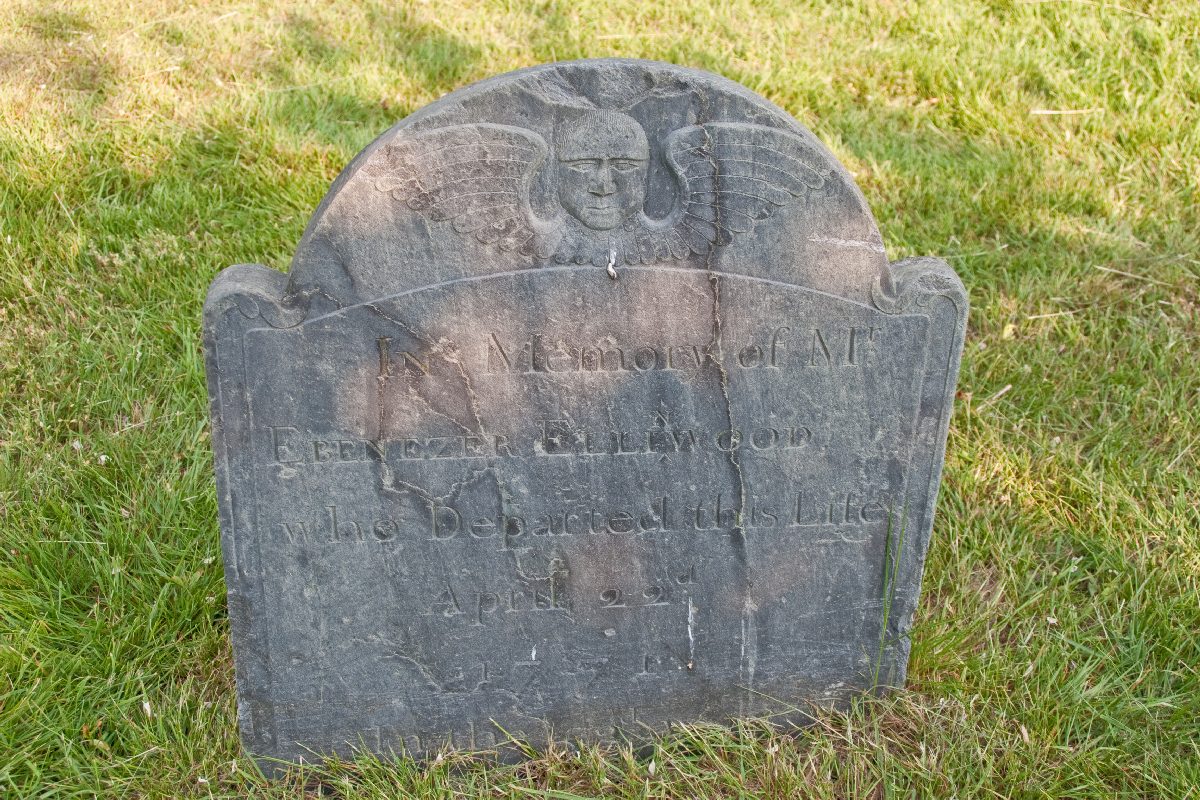
Grave of Ebenezer Ellingwood 
While neither of these are in my direct line of ancestors, they are close relatives of my many times great-grandparents and it is likely that they had contact with each other. I can't help but wonder what others in the family thought about slavery, equality, and the humanity of native and African people. 


http://www.celebrateboston.com/disasters/smallpox-epidemics.htm
http://dougsinclairsarchives.com/ellingwood/ebenezerellinwood.htm


Rev. John Maverick (father of Samuel) - 12th great-grandfather
Moses Maverick (brother of Samuel) - 11th great-grandfather
Abigail Maverick - 10th great-grandmother
Martha Ward - 9th great-grandmother
Martha Tuttle/Tuthill - 8th great-grandmother
Martha Haskell - 7th great-grandmother
Ruth Safford - 6th great-grandmother
Martha Haskell - 5th great-grandmother
Sally Houghton - 4th great-grandmother
Florilla Dunham - 3rd great-grandmother
Nina King Ellingwood - 2nd great-grandmother
Annie Florilla Gibbs - great-grandmother
Fern Lyndell Cotton - grandmother


Ebenezer Ellingwood (father of Ebenezer Jr) - 7th great-grandfather
Joseph Ellingwood (brother of Ebenezer Jr) - 6th great-grandfather
John Ellingwood - 5th great-grandfather
John Ellingwood Jr - 4th great-grandfather
Asa Freeman Ellingwood - 3rd great-grandfather & husband of Florilla Dunham (above)

Sunday, April 1, 2012

First Doctor in Bethel

Timothy Carter was born November 27, 1768 in either Ward, Massachusetts to Timothy and Sarah (Walker) Carter. He was a descendant of the immigrant Rev. Thomas Carter of Woburn, Massachusetts. He is my 4th Great-Grandfather and the source of my earliest interest in family history. Howard Lapham in The History of Bethel, Oxford, Maine: 1768-1890, Formerly Sudbury, Canada, says that when Timothy was 11 years old, his father, a house carpenter, fell from a building and was killed instantly and Timothy was sent to live with a family in Sutton. Lapham describes him as having "ability and pluck." While Lapham doesn't name the family that took Timothy in, he does provide one clue when he says Timothy worked for "the man in whose family he lived and who was a dealer in oil." 


Timothy's first wife was Frances "Fannie" Freeland, daughter of Doctor James and Mehitable (Mellen) Freeland. She was born September 4, 1771 in Sutton, Massachusetts. They met when Timothy came to study medicine under the tutelage of her father. They were married in 1793.


I'm not sure why they chose to leave Massachusetts and settle in Maine but in 1799 they moved to Bethel, Maine - the part of town along the Androscoggin River called Middle Intervale. Although this is several miles from the center of town now, Lapham calls the area a "center of influence" that was growing more rapidly than other sections of Bethel. At that time they had three small sons, Lawson, Galen and James. Family legend is that Frances was pregnant at the time and made the trip on side-saddle while pregnant with their fourth son, Timothy Jarvis. I remember seeing her side-saddle when I was growing up but I don't know where it is now. After moving to Bethel and giving birth to Timothy Jarvis, Frances & Dr. Timothy had three more children, Luther Cullen, Frances and my 3rd great-grandfather, Elias Mellen. 
Google Maps says it is 212 miles on present-day roads from Sutton to Bethel. By car it is 4 hours and 4 minutes but I'm sure it was a lot more challenging to make the journey on horseback while pregnant. 


Eva Bean in her book East Bethel Road,  calls Dr. Timothy Carter "the first physician to settle in town" and says they lived first in a home built by Enoch Bartlett that was later replaced by the house my grandparents lived in for most of my life. The family home built by Dr. Timothy is still in my family and the current resident is my cousin, John Carter. This house is called the Brick End House because it is indeed brick on one end. Frances died while the house was being built. She was only 44 years old and left behind six sons and one daughter. The five oldest sons married and moved away from Bethel but the youngest, Elias Mellen Carter remained and lived in the Brick End House. 

Dr. Timothy remarried before 1823 (first child born in 1823) to Lydia Russell. They had five children, Lydia, Sarah, Abigail, Theodore, and Benjamin - all of whom made Bethel their home. Portraits of Dr. Timothy and Lydia hang in the front parlor of the Brick End House. Dr. Timothy died February 25, 1845 and is buried across the road from the Brick End House in the Middle Intervale Cemetery. His family plot is surrounded by a wrought iron fence a few rows into the cemetery and just to the left of the gate. 

I plan to go this summer and get better pictures from the cemetery specifically of the graves of my ancestors but this is a generic photo of the cemetery. 

Howard Lapham in The History of Bethel, Oxford, Maine: 1768-1890, Formerly Sudbury, Canada, says that prior to the arrival of Dr. Timothy, people were left to their own devises or had to send to Fryeburg for a doctor. Lapham also tells of two other physicians who briefly practiced in Bethel. One was a German named Dr. Martin who came during the Revolutionary War with Baron von Steuben and followed some soldiers to settle in Maine. He was "a man of intemperate habits to such an extent as to disgust the people, even in those days of free frum and its liberal imbibation." In 1790, Dr. John Brickett was in Bethel but he married a woman from Haverhill, Massachusetts and returned to practice in that town. 

In addition, many in Bethel benefited from the natural remedies and treatments of Molly Ockett (her name is spelled in a variety of ways), a local Native American woman who traveled around western Oxford county tending to people. Every July, Bethel has a festival named in her honor - Mollyockett Day. She is a very interesting woman and I'll write more about her in a future post. Lapham says she "felt deeply chagrined when a physician came, and she realized she must seek a new field of work." This seems a bit extreme as I'm sure there were plenty of families in need of services to keep both of them busy. 

I have a bit more information about the practice of Dr. Timothy and information on his oldest 5 sons who went on to lead very distinguished lives, more about Elias Mellen Carter, and more about Molly Ockett so this post will be continued...