Showing posts with label cousins. Show all posts

Saturday, May 16, 2015

Branded Thief - Black Sheep 52 Ancestors #20

Zaccheus Perkins was my first cousin, 9 times removed. He was the nephew of my 8th great-grandmother, Frances (Gould) Shumway. Zaccheus was the son of Thomas & Phebe (Gould) Perkins. Zaccheus fought under Capt. Joseph Gardiner in King Philip's War and was present at the Great Swamp Fight (famous for the destruction of the Indian village of Narragansett). The Perkins family was from Topsfield, Massachusetts. 


After that experience, he seems to have gone down a bad path. He got in trouble by falling in with a thief, Nicholas Jennings (described as a Frenchman he met while serving in King Philip's War). They went out drinking and Zaccheus held the horses while Jennings went off and returned with a sack of goods that he later divided and shared with Zaccheus at the shop of Mr. Thomas Maule. 

Zaccheus was also implicated in the thefts of a silver cup belonging to Mr. Joseph Whiting, a gold ring belonging to Goodman Robinson, and goods and money from a Mr. Batten. 


On May 4, 1680, Zaccheus was convicted in the thefts and sentenced to be whipped and branded on the forehead with the letter "B", also to repay Mr. Maule £250 and Mr. Batten £24. 


Frances Gould & Peter Shumway, Sr.
Peter Shumway, Jr. & Mariah Smith
Hepzibah Shumway & Obadiah Walker
Sarah Walker & Timothy Carter
Dr. Timothy Carter & Frances Freeland
Elias Mellen Carter & Rebecca Williamson
Augustus Mellen Carter & Mary Frances Stanley
Edward Mellen Carter & Fannie May Capen
Thomas Richard Carter - my grandfather

Sunday, February 8, 2015

Birthday Matches - Saturday Night Genealogy Fun

Randy Seaver issues a weekly Saturday Night Genealogy Fun challenge. This week it is about birthdays. Just a couple of weeks ago, I wrote about my direct line ancestor with the birthday closest to mine. You can read about John Whiting here


The challenge this week is to find out if any of your ancestors or their siblings (your cousins!), were born on your birthdate?   

1)  What is your birth date (not the year, only month and day)?


My birthday is July 18th.    

2)  Review your records, or use your genealogy management program to create a list of persons in your database born on your birthdate.  Are any of them your ancestors or siblings of your ancestor?  Tell us how you figured it out too.

I ran a report using RootsMagic to determine which ancestors, both direct and collateral lines, shared my birthday. There are no direct ancestors with my birthday, but I do share my birthday with a number of cousins. 

I came up with the following:

Eleazer Scott - b. 18 July 1654 - my sixth great-granduncle & my earliest match
Jonathan Gardner - b. 18 July 1669 - my first cousin, 10 times removed
Ephraim Ford - b. 18 July 1693 - my first cousin, 10 times removed
Sarah Whiting - b. 18 July 1703 - my first cousin, 10 times removed, twin 
Mary Whiting - b. 18 July 1703 - my first cousin, 8 times removed, twin
Dorcas Chandler - b. 18 July 1727 - my second cousin, 9 times removed
Michael Foster - b. 18 July 1727 - my second cousin, 7 times removed
Lydia Abbott - b. 18 July 1809 - my third great-grandaunt
John S. Morgan - b. 18 July 1832 - my first cousin, 5 times removed
Rebecca Williamson - b. 18 July 1838 - my first cousin, five times removed & my closest match

3)  List one or more of those born on your birthdate in your own blog post, in a comment to this blog post, or on Facebook or Google+.  

Saturday, November 22, 2014

52 Ancestors #49 - Even The Drunkards Thank Us

Rev. Freeman Yates was my first cousin, 4 times removed. He was the son of William & Dorcas (Hall) Yates, and the grandson of William & Martha (Morgan) Yates, my fourth great-grandparents. The 19th century featured many reform movements but one of the strongest and longest lasting was the temperance movement, a precursor to the era of Prohibition of the 1920s. Maine was the first state to ban alcohol thanks to temperance reformer, Neal Dow. While researching my Yates ancestors I came upon the following article about a speech that Freeman Yates gave on the subject. 

Wisconsin Free Democrat (Milwaukee, WI), Wednesday, January 28, 1952, Vol. 8, Issue 8, Page 2. The Maine Liquor Law – No. 5 - Accessed on GenealogyBank, June 19, 2013

Remarks from the National Temperance Convention held at Saratoga Springs on the 20th of August, 1851. The Rev. Freeman Yates, editor of the Gardiner Fountain, spoke as follows:
“Under the old law, we could not get evidence. Men who drank would perjure themselves. The whole system of grog-selling was one of deceit and fraud. We formed a law to meet the enemy in every quarter. Mr. Dow received suggestions in his work from all parts of the State. But our Governor vetoed the bill on its first passage. The veto was his winding-sheet. This year it was passed by a two-third vote, and Governor Hubbard gave it his assent. I will show you its operation in Augusta, which has been called the great rum-hole of the State. (Here Mr. Yates read an extract from the Augusta Age which declared that every hotel and liquor shop had voluntarily cleared itself of the forbidden article.) In Bangor, said Mr. Yates, they have met with a most serious difficulty in carrying out the law. The director of the almshouse has usually employed sixty men, the victims of strong drink, to get in the hay. This year, these have been so scarce that he had to hire a set of sober men, at the city’s charge, or not have the hay gathered. (He then read from a Bath paper to show the operation of the law there.)…We hear nothing in Maine now, for mere moral suasion. All good men are for protection by law. Even the drunkards are with us; and they thank us, for removing the temptation, and that they now live and die sober men.”

I'm not convinced that the drunkards were thankful for removing the temptation. It also makes me chuckle that the almshouse now had to find sober men to get in the hay because drunk men were so scarce. 
Thank Goodness for the Maine Law!
William & Martha (Morgan) Yates
Moses & Martha (Whittle) Yates - brother of William Yates, Jr. - father of Freeman
Gilbert W. & Laura (Emmons) Yates
Estes G. & Eva D. (Hayes) Yates
Linona Alice Yates - my grandmother

Saturday, October 18, 2014

52 Ancestors #43 - Thomas Cousins - Attack at Black Point

In the late 17th century, settlers on the frontier suffered greatly from Indian attacks. Those settlers on the Maine coast were not part of the spread of settlers from Massachusetts and the Indians were seeking to halt the expansion and maintain their lands. The area that is now Scarborough encompassed a number of settlements including Black Point and Dunstan. From October 10-13, 1675, the settlers battled with the Wabanaki. Those at Dunstan were critical of the lack of support from Joshua Scottow's garrison at Black Point. Mary Beth Norton notes that several key figures in the Salem Witchcraft hysteria had connections to the area (see In The Devil's Snare, p. 141-143). 

My grandfather, Clayton Blake descends from Thomas Cousins who was serving in the company of Captain John Wincoll and gave the following deposition accusing Joshua Scottow of cowardice and failure to help those under attack. 

"The deposition of Thomas Cousens aged about 30 yeares makes oath that being with Capt. Winckoll when he was ingaged with the Indians neere Blackepointe and faire within sight of the garrison. Capt. Winckoll sent two men to Mr. Scottow for some reliefe, being then likely to have bene overthrowne, by the enimy, but the said Scottow would not send any help to us, he had at that time upward of forty men in his garrison, but from Mr. Foxwels garrison, which was as farr from us as Mr. Scottows garrison was, we have five men which did us a great pleasure, and they left but two men in the garrison, which if we had had releife from Mr. Scottows garrison, in an ordinary way with gods blessing, we might have given the enimye a great overthrow, and after the fight was over, this deponent went to Mr. Scottows garrison, and heard Souldiers generally say, that they see Capt. Winckoll ingaged with the enimy, and would have gone to have releived them. but Mr. Scottow would not suffer them, but charged them to Keepe the garrison, and further this deponent saith that it was generally reported at Blackpoint, that in theire great distress they could have no help from Mr. Scottows garrison, he being the comander thereof, and further saith not. 

Taken upon Oath the 16th January 1679
before me Sam'l Wheelwright
Comiss.

In answer to the charge, Capt. Joshua Scottow accused Thomas Cousins of perjury and although Thomas was acquitted, he was found guilty of a different charge, "presumptuous and reproachfull expressions" against Scottow. 

Thomas Cousins & Hannah Goodale
Hannah Cousins & George Jacobs
Priscilla Jacobs & Joshua Bartlett
Lydia Bartlett & Joshua Ripley
Nancy Ripley & Micajah Blake
Galen Blake & Dolly Moody
Charles G. Blake & Isabelle Brown
Harriet May Blake & ?
Clayton Leonard Blake - my grandfather


Sources: 
Norton Mary Beth, In The Devil's Snare
Davis Walter Goodwin, The Ancestry of Lydia Harmon


Thursday, October 9, 2014

52 Ancestors #42 - Isaac Cousins

Isaac Cousins was the 7th great-grandfather of Clayton Leonard Blake. He seems to have been a wanderer. I don't have any other colonial era ancestors who lived in as many places as he did. His occupation is listed as gunsmith and locksmith. Tracing his steps we find him in: 

Rowley in 1651, Haverhill in 1652, Ipswich about 1654, Boston in 1656, Portsmouth in 1659, Great Island in 1661, Boston in 1668, North Yarmouth, Maine in 1678, Dorchester in 1691, Boston in 1696-1702

Isaac Cousins married three times. His first wife was named Elizabeth and we don't know her maiden name. His second wife was Ann Hunt, whom he married in 1657. His third wife was Martha Priest. He seems to have been seeking to better his lot in life as he moved around and perhaps his best chance was when he became associated with the proprietors in North Yarmouth in Maine. However, Indian attacks doomed this settlement and the he moved back to the Boston area. In 1691 he was warned out of Dorchester and in 1696 he stated in a lawsuit against Richard Priest that he was "an ancient inhabitant of this country...fallen much into decay and waxen so poore." He claimed Richard Priest was withholding his household goods. By the time he died on July 23, 1702 he was a ward of the town. 


Isaac & Elizabeth Cousins
Thomas & Hannah (Goodale) Cousins
George & Hannah (Cousins) Jacobs
Joshua & Priscilla (Jacobs) Bartlett
Joshua & Lydia (Bartlett) Ripley
Micajah & Nancy (Ripley) Blake
Galen & Dolly (Moody) Blake
Charles & Isabelle (Brown) Blake
Harriet May Blake
Clayton Leonard Blake - my grandfather 

Thanks to the research of Walter Goodwin Davis, The Ancestry of Lydia Harmon, for the basic information in this post. 


Sunday, September 14, 2014

52 Ancestors #32 - A Fickle Female Loses Her Love

This story comes from Dow's History of Hampton, New Hampshire. He doesn't tell where the story comes from but I thought it was interesting. 

Maurice (or Morris) Hobbs, according to tradition, left his native country under the following singular circumstances. He had been paying his addresses to a young lady, who, from some cause not mentioned, turned him off; and thereupon, he determined to emigrate to America. When the lady knew of it, she relented, and, knowing he would pass her residence as he proceeded to embark, placed herself in his view, hoping to bring about a reconciliation. To her grief, she found him inexorable; and although she accosted him with the affectionate enquiry, "Whither goest thou, Maurice?" yet he deigned not to turn his head or to look upon her. And they never saw each other more. 


Morris came to Hampton, New Hampshire between 1640 and 1645. He married my 10th great grandaunt, Sarah, daughter of William Eastow. They had ten children. 

I always wonder about these family "stories" and how embellished they are. What is the story from the side of the young lady? 

William Eastow
Mary Eastow - sister of Sarah (Eastow) Hobbs - my 10th great grandmother
Ephraim Marston
Jeremiah Marston
Elisha Marston
Mary Marston
Hannah Prescott
Mary Edgecomb
Benjamin Perley Philbrick
Lizzie Philbrick
Ray Everett Cotton
Fern Lyndell Cotton - my grandmother

Wednesday, September 10, 2014

Wordless Wednesday - Ponies

My Grandfather, Richard Carter on pony with his youngest brother, Paul. Standing are his siblings, Becky & Stanley. 

Me riding Patches, a pony my grandfather bought for his grandkids

Me and my cousin, Nancy on Patches

Sunday, May 4, 2014

Saturday Night Genealogy Fun - How Many Cousins Do You Know You Have?


From Randy Seaver at Genea-Musings

Your mission, should you decide to accept it (cue the Mission Impossible! music) is to:

1) Take both sets of your grandparents and figure out how many first cousins you have, and how many first cousins removed (a child or grandchild of a first cousin) you have.

2) Extra Credit: Take all four sets of your great-grandparents and figure out how many second cousins you have, and how many second cousins removed you have.

3) Tell us the grandparents and great-grandparents names, but don't give the name of living cousins unless you want to.

4) Are there any of those lines that you don't know all of the cousins names? Do you care? 

5) Tell us about them in your own blog post, in a comment to this blog post, or in a Facebook or Google+ post of your own. Be sure to drop a comment to this post to link to your work.

Here is my entry: 
I struggled to come up with respectful terms for non-biological children. It is something that is tough to describe but easy in real life because they are just considered part of the family and equal to all other family members. For simplicity's sake, I will refer to all children the same but understand that a few of these relationships are based on love, not DNA. 

Part 1: 
My Carter grandparents were Thomas Richard & Fern Lyndell (Cotton) Carter. They had four sons. My father is the oldest. 

Son #2 has two daughters and one son. Child #1 (female) has one daughter; Child #2 (male) has no children; Child #3 (female) has one son and one daughter. 3 first cousins, & 3 first cousins, once removed. 

Son #3 had three daughters. Child #1 two daughters; Child #2 has one daughter and one son; Child #3 does not have children yet. 3 first cousins & 4 first cousins, once removed

Son #4 had three daughters. Child #1 has three daughters and one son; Child #2 has one son and one daughter; Child #3 has no children. 3 first cousins & 6 first cousins, once removed

My Blake grandparents were Clayton Leonard & Linona Alice "Peggy" (Yates) Blake. They had three daughters. My mother is the oldest. 

Daughter #2 has two daughters. Child #1 has three daughters; Child #2 has no children. 2 first cousins & 3 first cousins, once removed

Daughter #3 has two sons and 1 daughter. Child #1 (male) has no children; Child #2 (female) has two daughters; Child #3 (male) has three daughters. 3 first cousins & 5 first cousins, once removed

I have 14 first cousins and 21 first cousins, once removed. None of my first cousins have grandchildren. I am the oldest of the Carters and I have the first grandchild - born in October 2013. 


Extra Credit:
My great-grandparents:
1) Edward Mellen & Fanny (Capen) Carter - Had 5 children but only two had children and one of those was my grandfather. 

  • Edward Augustus Carter had one son & one daughter. The son had three daughters and the daughter had no children. Of the three daughters, only one has children - two boys and one girl. 
  • Rebecca Williamson (Carter) Bailey
  • My grandfather, Thomas Richard Carter had four sons.
  • Stanley Capen Carter
  • Paul Albert Carter 

Total = 2 second cousins & 3 second cousins, once removed & 3 second cousins, twice removed. I know everyone in this line. 

2) Ray Everett & Annie Florilla (Gibbs) Cotton - Had 8 children but only three had children.  

  • Albert Francis Cotton had one daughter. She had a son & a daughter. There are at least 4 grandchildren for Albert and at least 3 great-grandchildren. 
  • Nina Mae (Cotton) Laflin died at age nineteen without children.
  • Marion Elizabeth Cotton died young.
  • Ray Everett Cotton, Jr had one daughter and five sons. I know of 12 grandchildren of Ray, Jr. and I'm sure there are some great-grandchildren but I do not know their names. Yes, I wish I did. 
  • Thelma Jane Cotton died young. 
  • Leonard Henry Cotton died young. 
  • Ada Lillie Cotton had one son and two daughters. The son had 3 daughters & the daughters had 2 sons and a son and a daughter, respectively. I know all their names but I lose track of some at the next generation. I know of 4 great-grandchildren of Ada. 
  • My grandmother Fern Lyndell (Cotton) Carter had four sons. 

Total = 4 second cousins & 11 second cousins, once removed and bunch of second cousins, twice removed. I feel pretty good that I at least know a few of the second cousins, twice removed names. 

3) Harriet Blake - never married and had only my grandfather. No second cousins here. 

4) Estes & Eva Delphinia (Hayes) Yates - Had 8 children and these are harder for me. 

  • Lawrence Yates had at least two sons and two daughters and then I lose track. I know one of his daughters has one son and two daughters. 
  • Georgie Anna (Yates) Haines had at least three daughters and one son. I know the two children of the son. 
  • Carroll Yates had two sons but nothing further on this line. 
  • My grandmother Linona Alice (Yates) Blake had three daughters. 
  • Russell Yates had no children. 
  • Viva (Yates) Whitman had one son (no idea if he has children) and one daughter. I know the daughter has two daughters and several grandchildren. I know the names of her daughters but not Viva's great-grandchildren. 
  • Laura (Yates) (Adams) Hutchins had one son and one daughter. I know the daughter has one son and two daughters and several grandchildren. 
  • Bryce Yates had one daughter and two sons. I believe that both sons have not had children and the daughter has at least one daughter, one or two sons. 
Total = at least 17 second cousins & an unknown number of second cousins, once removed.  


At least 23 second cousins, and 27+ second cousins, once removed. 

Geography seems to play a part in this. Some lines I know more of the descendants because they lived nearby, went to the same schools, and family got together more often. On my mother's side, the extended family did not have the same get-togethers that my father's side did. I know more of the families of my mom's cousins who lived in the towns in our school district but not those who lived just a little bit further away. I wonder what it will be like for my children because the family is becoming increasingly separated by geography but increasingly connected by social media. 

http://www.geneamusings.com/2014/05/saturday-night-genealogy-fun-how-many.html

Saturday, April 19, 2014

Witness to Assassination - 52 Ancestors #10

Octavius K. Yates was my first cousin, 4 times removed. He was the son of James & Emma (Cole) Yates and the grandson of William & Martha (Morgan) Yates (my 4th great-grandparents). The Yates Book relates that Octavius was born on September 25, 1833 and after graduating from high school in Bethel, Maine, he enlisted in the Union Army during the Civil War. Octavius was at Ford's Theater on the night of April 15, 1865 when Abraham Lincoln was shot.

The following information comes from the web site www.fordstheater.org.

Ford's Theater was transformed from a church to a theater in 1861. The theater benefited from the influx of population as thousands of soldiers and wartime visitors passed through the city. The sloping ground level had about 600 wooden chairs. These could be removed for dances. The second floor balcony held 420 people in the same type of wooden chairs. The upper balcony seated 600-700 on wooden benches. There were four private boxes, two on either side of the stage.

It's hard to imagine what it was like for those in the theater on that night. The country was celebrating the end of the Civil War. They must have felt that the worst of the hard times was behind them.

After the Civil War, Octavius moved to Canada and was engaged in the oil business before returning to Maine and studying medicine. He became a respected physician in West Paris.

Sunday, September 8, 2013

Obituary Sunday - Julia F. Carter


This obituary comes from a newspaper clipping that my grandmother kept. Recently my sister found it while going through her keepsakes and gave it to me. I'm not sure what paper published it but I think it was probably the Lewiston Sun Journal.

Julia F. Carter
Paris - Julia F. Carter, 95, of Paris Hill and formerly of Cincinnati, Ohio died Wednesday at the Norway Nursing Home, where she had resided for several months.

Born in Montclair, N.J., Sept. 8, 1884, the daughter of Jarvis L. and Mary B. Carter. Miss Carter graduated from Montclair (N.J.) High School, Wheaton College (Mass.) in 1905 and Pratt Institute of Library Science in Brooklyn, N.Y. in 1906. After graduation, she became the first full-time children's librarian at the New York Public Library. During her fifteen years there, she was granted leaves of absence to assist in the children's divisions in the libraries in Cleveland, Los Angeles, and Portland, Ore.

In 1918, she led a Red Cross unit in World War I, directing a library for American troops near Dijon, France, and Trier, Germany, following the Armistice. After the war she returned to the New York Public Library, and in 1924 became the children's librarian at New Haven, Conn. In 1927 she began a 28 year career with the Cincinnati Public Library where she was supervisor of the children's department of the entire library system of Cincinnati and Hamilton County, Ohio. She directed the opening of 14 branches.

Miss Carter presented the first Caldecott Medal and was the first national president of the Division of Library Work with Children and Young People of the American Library Association. She was the first president of the Zonta Club of Cincinnati; the Cincinnati Library children's room was furnished in her honor by Zonta International. A bronze plaque and other honors displayed in the library commemorate her long service there.

Winner of the first Caldecott Meda
In 1955 she retired to her family home in Paris Hill, where she assisted in the Hamlin Memorial Library  program, conducted correspondence, collected memorabilia of the town's history and was historian of the Paris Hill Historical Society. She was also an honorary member of the educational society Delta Kappa Gamma.

Survivors include her sister Mrs. Roger (Dorothea) Davis of the Norway Nursing Home; two nieces, Mrs. J. Eric (Nancy) Bucher of Oklahoma City, Okla., and Paris Hill, and Mrs. A. K. (Frances) Alexander of Paris Hill with whom she resided; two grandnieces; two grandnephews; and two great-grandnieces.

Julia F. Carter was my 3rd cousin, twice removed. She died in January 1980. 
Dr. Timothy & Frances (Freeland) Carter were her 2x great-grandparents. They are my 4x great-grandparents.  They were the parents of, among others,  Elias Mellen Carter and Timothy Jarvis Carter.

Elias Mellen & Rebecca (Williamson) Carter, Augustus Mellen & Mary Frances (Stanley) Carter, Edward Mellen & Fanny May (Capen) Carter, Thomas Richard & Fern Lyndell (Cotton) Carter - my grandparents.

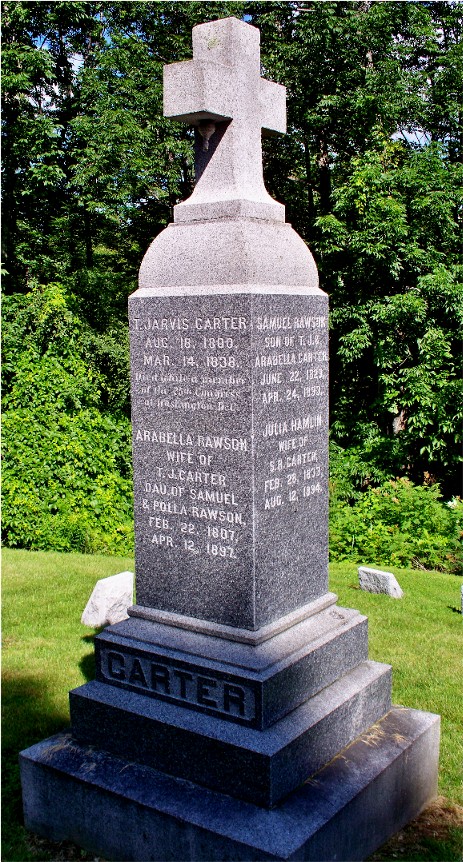
Timothy Jarvis & Arabella (Rawson) Carter, Samuel Rawson & Julia (Hamlin) Carter, Jarvis Livermore & Mary Blanche (Carter) Carter (Julia's parents were 2nd cousins), Julia F. Carter - my 3rd cousin, twice removed. 
http://www.zonta.org/


Tuesday, January 1, 2013

Accentuate the Positive!

After reading some postings about what genealogy bloggers had not accomplished in the past year, an Australian geneablogger, Geniaus, issued the following challenge: Respond to the following prompts to document the year's accomplishments. Since I didn't set any genealogy goals for last year, I have nothing to lament. I am intrigued to see what I accomplished. The original post includes more than I've included here because not everything applies to me. Here are my positive accomplishments to accentuate! 

  1. An elusive ancestor I found was:
    • My great-great-grandmother, Lizzie Philbrick - My great-great-grandfather was married three times and figuring out the identity of the mother of my great-grandfather was challenging until I found a record of his marriage with his parents listed on the reverse. Now I know who Grammie Philbrick was! 
  2. A precious family photo I found was:
    • I'm taking some liberties with this, my precious photos were taken by my Grandmother Carter. She loved flowers and I love these pictures of she took of the flowers around her house. 
  3. An ancestor's grave I found was:
    • The grave of Cyrus Buck with an unusual epitaph referring to Deism.
  4. An important vital record I found was:
    • A Revolutionary War pension file that detailed the service of my 5th great-grandfather, Dominicus Smith, including the fact that he was with George Washington when he crossed the Delaware. 
  5. A newly found family member who shared: 
    • Bill West - a cousin and fellow geneablogger is responsible for inspiring me to start my blog and he's been one of my biggest supporters. I am so grateful! 
    • Also a big thank you to Chris Dunham of Maine Genealogy Network for his help with several challenges this year. 
  6. A geneasurprise I received was:
    • Being included in Heather Wilkinson Rojo's blog post on Follow Friday. Heather and I have several ancestor connections and I love her blog Nutfield Genealogy
  7. My 2012 blog post that I was particularly proud of was:
  8. My 2012 blog post that received a large number of hits or comments was:
    • The most hits have been on this post about St. George's Day. I wrote it because it's also my mom's birthday and her ancestry is very British so it seemed fitting. 
    • The most shared was this post titled When Your Family Tree Doesn't Fork.
  9. A social media tool I enjoyed using for genealogy was:
    • I have to say Facebook because I connect with cousins, enjoy pages by genealogical, historical, and family associations and get updates when new content is published on some of my favorite blogs and web sites. It is also the greatest source of readers according to my Blogger stats. 
  10. I taught a friend how to:
    • I'm going to modify this one too, I taught my students to appreciate family history and the joy of tracking down ancestors. 
  11. A new genealogy/history book I enjoyed was:
    • The Devil of Great Island - I have ancestors who lived nearby and interacted with some of the principle players in this story. 
  12. Another positive I would like to share is:
    • big thank you to the genealogists who share their stories, tips, techniques, and research with others. I have learned so much from you. 


Monday, November 5, 2012

Politics Will Make You Crazy

Timothy Jarvis Carter was born in Bethel, Maine to Dr. Timothy and Frances (Freeland) Carter. He was the older brother of my 3rd great-grandfather, Elias Mellen Carter. He died in Washington, D.C. at the age of 38. His good friend and fellow Maine represenatative, Jonathan Cilley, had been killed in a duel on February 24, 1838. Timothy was so upset over the death of his friend that he went insane and died on March 14, less than a month afterwards.

From the Daily Ohio Statesman, March 21, 1838
We have but little Express news. Both Houses of Congress attended the funeral of the Hon. Timothy J. Carter, a member from Maine, on Saturday last. Mr. Carter was confined to his room at the time of Cilley's murder. On hearing of that fatal deed, he became insensible and never fully recovered. 

From the New Hampshire Patriot, April 9, 1838
DEATH OF HON. T. J. CARTER - The melancholy duty devolves upon us to-day to announce the death of another member of the delegation in Congress from this State. - The Hon. T. J. CARTER is no more. The particulars of his death will be found in the subjoined letter of a correspondent...He was one of the most pleasant and amiable men living - and was strongly endeared to a large circle of personal and political friends, who will deeply regret his early death. Although not in the habit of participating in debate, he possessed a sound and discriminating mind - and his opinions were entitled to, as they received, the respectful attention of his friends. 
From out Correspondent
Washington City, Thursday Morning
March 15th, 1838
Dear Sir: - Again the badge of mourning is hanging at the door of Berth's boarding house - the friend, the colleague, the fellow boarder of the martyred Cilley has followed him to the land of shadows - the Hon. Timothy J. Carter is no more. Mr. Carter's health has been feeble for several months past, but, as he himself informed me within the past month, he was getting better, and until the day that consigned his noble hearted colleague to the tomb, he was regularly in his place in the House. On that day, while the parties were out, I conversed with him while in hope that the affair would be amicably settled and that both parties would return unharmed! Alas! had that hope been realized, Maine would not now be called to mourn over two of her most upright and promising young men. The shock occasioned by such an effect upon Mr. Carter that his brain became disordered, and I have been told that in his delirium his constant idea was that he had been challenged to fight a duel. He continued to lose his strength gradually, under the effects of his disease, until last night, when death terminated his sufferings. With a sad heart do I reflect upon what has occurred here within the past three weeks, and with feelings in my bosom that I dare not trust my pen to express I leave this melancholy subject with a hope and conviction, that these mournful events will have the moral effect which shall cause the whole nation to frown down a practice only worthy of barbarians in a barbarous age. 

From the National Aegis, March 28, 1838
The following beautiful eulogium, upon the character and virtues of this gentleman was pronounced by Mr. Evans, in announcing his death to the House of Representatives, of which he was a member. 
Mr. Speaker - These bades of mourning which we still wear denote that death has been in the midst of us. Again his arrow has flown; and again has the fatal shaft been sent, with unerring aim, into a small and already broken rank. it is my melancholy office to announce that since the last adjournment of the House of Representatives, Timothy Jarvis Carter, then one of its members, from the State of Maine, has surrendered up to the Being who gave it, a life upon which many anxious hopes depended, and for whose preservation many an ardent prayer had gone up to the Father of all spirits. He died last evening at 10 o'clock, at his lodgings in this city, after a sickness of not very protracted duration, but of great and excruciating intensity of suffering and agony. The ways of a righteous Providence are inscrutable, and while we bow in submission, we are not yet oppressed with deep and solemn awe. 
Our deceased friend and colleague, was a native of the State and the district which, so lately, he represented in this branch of Congress; and he, therefore, brought with him the confidence, largely bestowed, of those who had known him from his earliest years. Well did he deserve it. His character for probity, integrity, uprightness, morality, was free from spot or blemish. His principles were well founded. Loving the country of his birth, and its institutions, with all his heart, he pursued with fidelity such measures as his judgment deemed best calculated to promote the welfare of the one and the durability of the other. He was a lawyer by profession, faithful, just, discriminating, attentive, humane, in its practice. 
Of manners, mild, courteous, affable; and a temper, kind, conciliating, patient, he won respect and attachment, even from those who differed from him in matters of opinion; and probably there lives not human being who has a single resentment, or one unkind recollection to bury in his grave. He has gone in the strength of manhood, and the maturity of his intellect, the road that all must once pass: - "calcanda semel, via, lethi."
The ties that bound him to life are severed forever, as all human ties must be severed. 
"Liuquenda tellus, et domus, et amaus
Uxor; neque harem quas celis, arboruia
Te practer lavisas cupressos
Ulla, broven dominum secuffiur"
Although when his eyes opened for the last time upon the earth and the sky, they fell not upon his own native hills; though the sod which will cover him will not freshen in the same influences which clothe them in verdure and beauty; though he died far from home, the companions and the brothers of his childhood were with him, - the sharer of his joys, the solace of his griefs, stood by him, and the hand which could best do it assuaged the bitter pains of parting life. The last earthly sounds which fell upon his ear were tones of sympathy and kindness, and affection, and support - tones which ceased not, even when they vainly strove to pierce the cold and leaded ear of death. Tears shall flow copiously, and deep sighs be heaved over his lifeless form; tears not more scalding, sighs not deeper drawn, nor mingled with any bitter recollections - any unavailing regrets. 
If human means could have availed - if devoted, fraternal sympathy and care - if constant, abiding, self-sacrificing affection, triumphing over exhausted nature and bearing up a feeble frame, unconscious of weariness, through long and painful vigils, would have saved his life, he would have been spared to the friends who now deplore his death and to the State and to the country which he served. To that stricken bosom we proffer - alas! How little will it avail! - our sincere sympathy and condolence. He has gone from this place of earthly honors and human distinctions, to a seat in that "House which is not made with hands, eternal in the Heavens." 


Photo Credits - http://www.findagrave.com/cgi-bin/fg.cgi?page=gr&GRid=39386650
Newspaper articles accessed on Genealogy Bank www.genealogybank.com

Thursday, July 5, 2012

Josiah Winslow - Governor of Plymouth Colony

My mother's ancestry goes back to the Winslow family who were some of the earliest settlers of Plymouth. Edward and Gilbert were passengers on the Mayflower, brother John came on the Fortune in 1621 and the two younger Winslows, Josiah and Kenelm came about 1631. My family descends from Kenelm so this Josiah is my first cousin, 11 times removed.


Josiah Winslow, shown here was the 13th Governor of Plymouth Colony, serving from 1673 to 1680. He was born in 1628 to Edward Winslow and Penelope Pelham (daughter of Herbert Pelham, the first treasurer of Harvard College). Josiah was the first governor of Plymouth born in the New World. By the time he took office, the colony was well established and no longer reliant on Native Americans to teach the colonists survival skills. The expanding British settlements of Plymouth and Massachusetts Bay were expanding and putting pressure of the lands of the Native Americans. Chief of the Wampanoag, Metacom (or King Philip) and Josiah did not have a good relationship and this contributed to the outbreak of King Philip's War. Josiah's half-brother was Peregrine White, the first English child born in New England.

Wednesday, June 20, 2012

Love Thing


My 8th great-grand uncle, Thomas Wentworth, married a woman named Love. He was a mariner and probably remained at sea most of his life since his inventory shows no property other than real estate. After his untimely death at the in August of 1719, his widow married John Thing.

She became Love Thing!


How would you like to go through life with that name?

Ezekiel Wentworth & Elizabeth (possibly Knight)
Tamsen Wentworth & John Hayes - Tamsen was the sister of Thomas Wentworth
Hezekiah Hayes & Margaret Cate
William Hayes & Olive
Isaac Hayes & Alice Garland
Richard Hayes & Rebecca
Sydney Hayes & Aphia Delphina Cole
George H. Hayes & Anna J. Rowe
Eva Delphinia Hayes & Estes Yates
Linona Alice Yates

Image Source: http://shopisabel.com/viewcategory.php?groupid=8

Friday, May 11, 2012

It's All Fun & Games

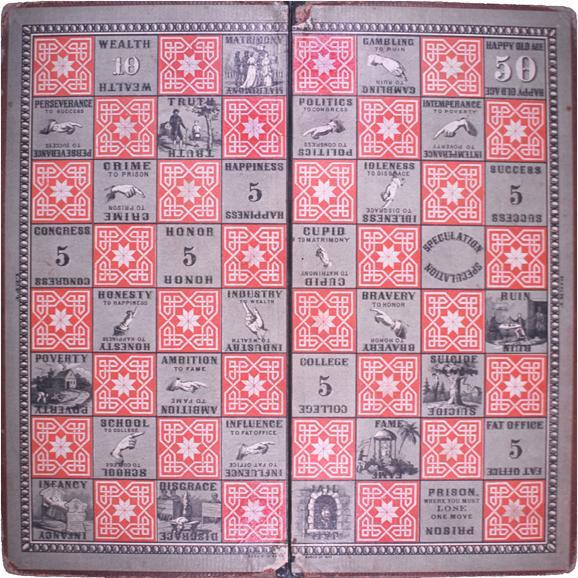
Milton Bradley is my 2nd cousin 5X removed. His grandfather and my 5th great-grandmother were brother and sister. Milton was born November 8, 1836 in Vienna, Maine to Lewis Bradley and Fanny Lyford. His grandfather was M. Dudley Lyford, older brother of Nancy Lyford. He began is career as a lithographer before he printed and sold a parlor game called the Checkered Game of Life. In 1864 he formed Milton Bradley and Company to print games and game manuals.
File:CheckeredGameofLife.jpg
Checkered Game of Life - MB's First Game
File:Milton bradley portrait.jpg
Nancy Lyford - 5th great-grandmother - M. Dudley Lyford
Oliver Smith Philbrick - 4th great-grandfather
Benjamin Philbrick - 3rd great-grandfather
Lizzie Philbrick - 2nd great-grandmother
Ray Everett Cotton - great-grandfather
Fern Lyndell Cotton - grandmother

http://www.biography.com/people/milton-bradley-9223556

Sunday, April 22, 2012

Black Sheep Sunday - Slaves in the Family

Usually I find the blogs of other genealogists intelligent, thoughtful and interesting. Yesterday I found one that disturbed me. The blogger offered a critique of the PBS show Finding Your Roots, hosted by Henry Lewis Gates, Jr. The author of this critique found the show "boring" and speculates that it would not appeal to a wide audience because it seems Gates has an "agenda" to make every show about slavery or find black ancestry of white people or vice versa. I do agree that the show could focus more on how the information is found but I suspect more people tune in for the family stories than the how-to's of genealogy. 


As a historian, I find this idea that connecting New England families to slavery is "digging up dirt" or connotes the bias of Gates disturbing because the author doesn't seem to understand that slavery is not just about the South and not just about black people. Slavery is deeply intertwined in the history of New England and white people. Slavery was legal in all colonies and tied to the occupations of shipbuilders, merchants, and sea captains, key components of the New England economy. As a U.S. history teacher in Maine, I struggle every year to convince students that slavery is part of the history of New England. In addition, I find the show fascinating because it shows that race is not clearly defined and, pardon the pun, history is not black and white - rather we are all human no matter what color our skin may be. As a genealogist, I wonder why one would expect that Gates would not showcase his area of expertise, the ancestry of African-Americans. Personally, I find it fascinating to see how a genealogist works to put together information about a group of people who are difficult to document. 


So far, I have found several indirect links between my New England ancestors and slavery. Today I present two of those stories. 


Samuel Maverick was born in 1602 and is the brother of my 11th great-grandfather. Their father was Rev. John Maverick who brought his family from Beaworthy, Devonshire, England in 1630 and became the one of the first ministers in Dorchester, MA. Samuel settled at Noddle's Island (currently part of Logan Airport after the strait separating it from the mainland was filled in the 1940s). Samuel purchased several slaves who were natives of Tortuga. My cousin and fellow genealogist, **Bill West, wrote about an appalling incident describing how Samuel, wishing to breed more slaves, ordered a male slave to force himself on one of the female slaves. Then one has to consider the contrast of the account by John Winthrop commenting on Samuel's kindness to Indians during a smallpox epidemic. "Among others, Mr. Maverick of Winnesemett is worth of a perpetual remembrance. Himself, his wife, and servants went daily to them, ministered to their necessities, and buried their dead, and took home many of their children." He reportedly buried 30 Indians in one day and took in many orphaned children. Now the question becomes, did he take in those orphans as slaves? 
Noddle's Island
**Bill's post includes information about another interesting story of slavery and the Upton family in New England. 


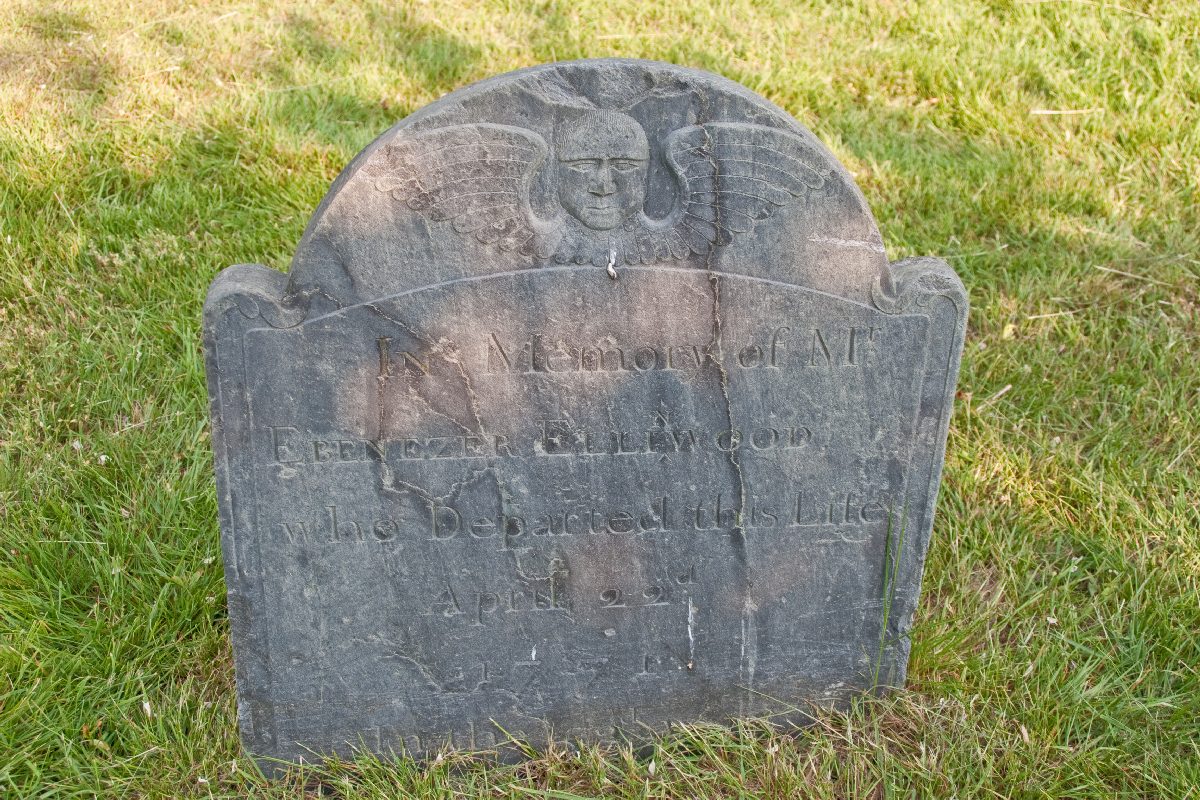
Ebenezer Ellingwood Jr. (6th great-granduncle) and his brother William were business partners. They were sea captains who sailed to Barbados among other places. Tax records reveal the brothers suffered some losses in their business and in the 1750s he was a hogreeve (overseer of pigs) for Beverly and applied for a license to operate a tavern and inn. Later court records and his estate list him as a yeoman suggesting he had retired from operating a tavern and inn shortly before his death at the age of 53. This is condensed from a posting at dougsinclairarchives.com. A longer explanation of Ebenezer's life with additional sources can be found at his site as well as information on other Ellingwood relatives. Part of the information he shares are stories about the slaves of Ebenezer Ellingwood. 


Ebenezer was abated part of his taxes for the "loss of his negro" in 1758, who is undoubtedly the unnamed slave of Ebenezer in Rev. Hale's Beverly death records who drowned in that year. Those records also mention the death of a slave infant in 1757. The tax list for 1760 includes two slaves. One may have been Jethro, who is known to have been with Ebenezer in 1763. Jethro is the only slave named in Ebenezer's estate inventory. It is very likely Jethro who was beaten by Thomas Diall in 1764. Ebenezer brought him to court for the offense and for trespass and won a judgement of 9 shillings and court costs.
Grave of Ebenezer Ellingwood 
While neither of these are in my direct line of ancestors, they are close relatives of my many times great-grandparents and it is likely that they had contact with each other. I can't help but wonder what others in the family thought about slavery, equality, and the humanity of native and African people. 


http://www.celebrateboston.com/disasters/smallpox-epidemics.htm
http://dougsinclairsarchives.com/ellingwood/ebenezerellinwood.htm


Rev. John Maverick (father of Samuel) - 12th great-grandfather
Moses Maverick (brother of Samuel) - 11th great-grandfather
Abigail Maverick - 10th great-grandmother
Martha Ward - 9th great-grandmother
Martha Tuttle/Tuthill - 8th great-grandmother
Martha Haskell - 7th great-grandmother
Ruth Safford - 6th great-grandmother
Martha Haskell - 5th great-grandmother
Sally Houghton - 4th great-grandmother
Florilla Dunham - 3rd great-grandmother
Nina King Ellingwood - 2nd great-grandmother
Annie Florilla Gibbs - great-grandmother
Fern Lyndell Cotton - grandmother


Ebenezer Ellingwood (father of Ebenezer Jr) - 7th great-grandfather
Joseph Ellingwood (brother of Ebenezer Jr) - 6th great-grandfather
John Ellingwood - 5th great-grandfather
John Ellingwood Jr - 4th great-grandfather
Asa Freeman Ellingwood - 3rd great-grandfather & husband of Florilla Dunham (above)

Thursday, April 19, 2012

Aftermath of the Shot Heard 'Round the World

The case of Uriah Thayer illustrates some of the challenges of documenting service in the Revolutionary War. It would seem from the pension requests of my ancestors that virtually no one kept any paperwork pertaining to their service and in some cases there was no paperwork to be kept. I have seen a few that state they were verbally discharged without formal papers. These verbal discharges seem to be from the beginning of the war. Uriah came from Braintree and joined Silas Wild's Company of minutemen who assembled on April 19, 1775. After 9 days he was sent home but would later join the army again at least 3-4 times and possibly more. His wife, Phebe (Hayden), states in the pension records that he was gone for most of the first three years of their marriage. Other soldiers state that they believe he served for the better part of 5 years. Despite these testimonies, there is only documentation of a little over a year of service when it is all consolidated. Further complicating the process of obtaining a pension, Uriah died in 1805, well before the 1818 law providing for pensions. Phebe was illiterate (based on her signing the application with her mark - see below). She ended up getting a pension for $39 that was later raised to $50 per annum. At the age of 92, she was still corresponding with the government, applying for a land bounty. I cannot find proof that the land bounty was granted but it may have been.

Piecing together the 74 pages of his pension record (the longest I have encountered), Uriah responded to the call for troops when the British marched on Lexington and Concord. He spent time in Boston guarding the harbor and was serving with General Benjamin Lincoln when he supervised the evacuation of the British. He may or may not have fought at Saratoga or gone on an expedition to Canada.

I doubt any of the men responding to the alarm from Lexington and Concord gave a thought to pensions or what their families might need from the government in the future. I'm sure they didn't envision the bureaucracy and red tape they or their spouses would encounter when trying to access their benefits.
Raising the Alarm

Uriah Thayer - 4th cousin 7 times removed (closest relationship)
Common ancestors - Samuel Bass to T. Richard Carter
John Alden to Linona Alice Yates
Thomas Rogers to Fern Lyndell Cotton