Showing posts with label innkeeper. Show all posts

Saturday, August 20, 2016

Thomas Gardner - Immigrant Ancestor

Thomas Gardner was an early immigrant to Cape Ann and later Salem. It is believed that he arrived in 1624 and from 1626 to his death, he lived in Salem. His estimated birth year, 1592, is based on his testimony given November 26, 1661. He indicated that he was about sixty-nine years old. He died in Salem on December 29, 1674, a month after his third wife died. His sons, George and Samuel served as executors of his estate.

Regarding his education and service to the town, he signed his name, rather than making a mark and he served as a deputy for Salem to the General Court in 1637. From 1641-1658, he served on several juries and was the foreman at least twice. Thomas served multiple terms as a Salem selectman and multiple terms as an overseer of highways.   He was a fence viewer in 1636, constable in 1639, and rater in 1639-1640.

There is no indication of a specific profession practiced until the 1660s. During the 1660s, he was granted a license to be an innkeeper and sell "strong drink." In 1667, his license was amended to forbid him from selling "strong drink" to the local folks. He could only sell it to "strangers."

In 1636, he appears in a list of Salem church members, but a court record calls his commitment into question. In November 1660, among a list of Quakers, the wife of Thomas Gardner, Sr. was one of those fined for frequent absences from church on Sundays. Thomas was never mentioned for having absented himself from church and it is difficult to know his feelings about the matter.

Thomas Gardner was married three times. The name of his first wife is unknown. She probably died around 1636 and possibly in child birth. His second wife was named Margaret, but her maiden name was unknown. His third wife was Damaris, "widow Shattuck," and her maiden name is also unknown. The American Genealogist Vol. 30 has an article about the identities of Margaret and Damaris.

Thomas Gardner and his first wife are my tenth great-grandparents.

Thomas Gardner's children with his first wife were:
  1. Thomas born about 1614. 
  2. George born about 1616. 
  3. John born about 1624.
  4. Sarah born about 1627. Sarah married Benjamin Balch, son of immigrant, John Balch. 
  5. Samuel born about 1629. 
  6. Joseph born about 1630. 
  7. Richard born about 1632. 
  8. Miram born about 1635. 
  9. Seeth (daughter) baptized in Salem on December 25, 1636. 
My Line:
Thomas Gardner
Sarah (Gardner) Balch
Mary (Balch) Stone
Ruth (Stone) Morgan
Luke Morgan
Samuel Morgan
Martha (Morgan) Yates
Moses Yates
Gilbert William Yates
Estes Gilbert Yates
Linona Alice Yates - my grandmother

The Great Migration Begins: Immigrants to New England 1620-1633, Volumes I-III. (Online database: AmericanAncestors.org, New England Historic Genealogical Society, 2010), (Originally Published as: New England Historic Genealogical Society. Robert Charles Anderson, The Great Migration Begins: Immigrants to New England 1620-1633, Volumes I-III, 3 vols., 1995).

Sunday, May 11, 2014

52 Ancestors #16 - John Emery


John Emery is my 11th great-grandfather on my dad's side and my 12th great-grandfather on my mother's side. He came from Romsey, Hampshire, England on the James in 1635 and settled in Newbury, Massachusetts. He was a carpenter and an innkeeper. I wrote about John Emery, his wife Alice Grantham, and Downton Abbey in March 2013. John Emery married second, Mary (Shatswell) Webster, daughter of John & Judith Shatswell and widow of John Webster. 


On May 5, 1663, John Emery was in court because he was accused of entertaining Quakers . He was presented by the constable, Henry Jaques, "for as much as John Emerie, Sr. is one of our grand jury men this last year for our town of Newbury and he himself having broken the law as I do understand in entertaining of travellers and quakers into his house and and one Mr. Greenland in all which disorder he have boldly insisted whereby reproach and scandal is to come upon our town to the dishonor of God and damage and hurt to some of your neighbors." 

Quakers were banished from Massachusetts and faced serious consequences if they returned. One of the more famous cases was that of Mary Dyer. I wrote about my ancestor, Humphrey Atherton's role in her case in March 2012. The tension between Quakers and Puritans is explained on this web site.

The children of John & Alice (Grantham) Emery:

  1. Alice Emery was born about 1622 and married John Chater. 
  2. Eleanor Emery was baptized on November 7, 1624 in Romsey and died in 1700. She married John Bailey and had ten children. I have lines of descent from two daughters.
  3. John Emery, Jr. was baptized on February 3, 1628/29 in Romsey and died November 3, 1683 in Newbury, Massachusetts. He married my 9th great-aunt, Mary Whipple. 
  4. Anne Emery was baptized on March 18, 1632/33 in Romsey and married James Ordway. 
The children of John & Mary (Shatswell) (Webster) Emery: 
  1. Ebenezer Emery (a girl) was born on September 14, 1648 and married John Hoag. 
  2. Jonathan was born on May 13, 1652 and married Mary Woodman. 

John Emery
Eleanor Emery
Sarah Bailey - Sister of Rebecca Bailey
Eleanor Cheney
John Safford
Ruth Safford
Martha Haskell
Mary "Sally" Houghton
Florilla Dunham
Nina King Ellingwood
Annie Florilla Gibbs
Fern Lyndell Cotton - my grandmother

Rebecca Bailey
Ruth Brown
Isaac Rogers
Rebecca Rogers
Stephen Blaisdell
Susannah Blaisdell
Stephen Blaisdell Rowe
Charles H. N. Rowe
Anna J. Rowe
Eva Delphinia Hayes
Linona Alice Yates


Saturday, May 10, 2014

52 Ancestors #15 - James Cole


John Sprague spent several hours in the stocks on at least one occasion for "highly misdemeaning himself in the house of James Cole of Plymouth near unto or on the evening before the Sabbath Day, in drinking, gaming and uncivil reveling, to the dishonor of God and the offense of the government, by his gaming and the bringing of his mare uncivily into the parlor of James Cole, aforesaid." 
(Saints and Strangers by George Willison)

James Cole is my 10th great-grandfather. He was a sailor and opened the first inn or public house in Plymouth and one of the earliest public houses in all of New England. His son, also named James, bought the public house in 1668 and James sold it to William Shurtleff in 1689. William Shurtleff is my 9th great-grandfather. Lucy Shurtleff is also my 4th cousin 7 times removed on my grandmother, Fern Lyndell Cotton's line. 

This raises a number of questions in my mind. What does it mean that he brought the mare uncivily into the parlor? Does that mean that he created a ruckus and if he had lead her in civilly it would have been okay? What happened that caused him to bring the mare into the parlor? 


What's the funniest story you've come across while researching your ancestors? 

James Cole & Mary 
James Cole & Mary Tilson
John Cole & Susanna Gray
Joseph Cole & Mary Stevens
Eleazer Cole & Lucy Shurtleff - great-granddaughter of William
Calvin Cole & Elizabeth Swan
Calvin Cole, Jr. & Betsy Judkins
Aphia Delphinia Cole & Sydney Hayes
George H. Hayes & Anna J. Rowe
Eva Delphinia Hayes & Estes Yates
Linona Alice Yates

Cotton connection to the Shurtleffs - 
John Dunham - common ancestor - Lucy's 3rd great-grandfather and my 9th great-grandfather. His descendant, Florilla Dunham, married Asa F. Ellingwood, Nina Ellingwood m. George Gibbs, Annie Gibbs m. Ray Cotton, Fern Lyndell Cotton - my grandmother

Sources:
Cole, Earnest Byron, The Descendants of James Cole of Plymouth, (New York, The Grafton Press: Genealogical Publishers, 1908.) pp. 21-22

Saturday, March 29, 2014

52 Ancestors #9 - Thomas Lewis

Thomas Lewis came from Shrewsbury, Shropshire, England to Saco, Maine (then MA) in 1628. He returned to England for a bit and then is back in Saco by June 28, 1631. The date of birth for Thomas Lewis is estimated as about 1590. The Great Migration says he was born in Shrewsbury to Andrew and Mary (Herring) Lewis. In May 1637, we know he was still living as he was sued by his future son-in-law, Richard Gibson for debt. However, he is called "deceased" in court records from April 28, 1640. 


The Council for the Affairs of New England in America granted a patent to Thomas Lewis, gentleman and Captain Richard Bonython on February 12, 1629. This patent extended along the north side of the Saco River for four miles from the mouth of the river and eight miles inland. In return for the patent, the patentees were required to transport fifty people to their colony in the next seven years and pay a small annual rent tot he Council. Thomas Lewis was a vinter and the owner of a tavern in Shrewsbury, Shropshire, England called "The Sextry." This tavern was run by his partner, George Cleeve (another Maine immigrant). The web site "Discovering Shropshire's History" has a great deal of information about the tavern which it calls "one of Shrewsbury's best-known and most prestigious taverns." It says Thomas Lewis is of Welsh origin and his parents were Thomas Lewis, a draper and alderman and the daughter of Robert Ireland, Jr. This is in conflict with the information provided by the Great Migration Begins sketch. 


On August 29, 1618, Thomas Lewis married Elizabeth Marshall at St. Chad's, Shrewsbury. Elizabeth was the daughter of Roger and Katherine (Mytton) Marshall. Her will was executed on October 8, 1640 so she likely died shortly before that date. 
St. Chad's Old Church built in the 7th century - a new church was built in 1792
Children: 

  1. Mary Lewis was baptized at St. Chad's on June 28, 1619. She married Rev. Richard Gibson in late 1638. It would seem this was not a love story from the court testimony as follows "which marriage was thought a fit means of closing the differences and settling an order both for religion and government...some troublous spirits...have cast an aspersion upon her...which tends to her utter infamy...I married the maid upon long demures..."
  2. Susanna Lewis was baptized at St. Chad's on November 2, 1620 and there are no further records for her. 
  3. Margaret Lewis was baptized at St. Chad's on April 22, 1622 and there is no further records for her. 
  4. Elizabeth Lewis was baptized at St. Chad's on April 7, 1623 and married Robert Haywood of Barbados before March 29, 1662. 
  5. Andrew Lewis was baptized at St. Chad's on February 22, 1624/5 and buried at St. Chad's on November 15, 1625. 
  6. Judith Lewis was baptized at St. Chad's on October 23, 1626 and married James Gibbons (Gibbins) before 1648 - based on the birth of their first child. 
  7. Andrew Lewis was baptized at St. Chad's on March 25, 1628 and there are no further records for him. 
Thomas Lewis
Judith Lewis
Rachel Gibbons
Thomas Edgecomb
Gibbins Edgecomb
Thomas Edgecomb
Mary Edgecomb
Benjamin Perley Philbrick
Lizzie Philbrick
Ray Everett Cotton
Fern Lyndell Cotton - my grandmother


Ancestry.com. The ancestry of Charity Haley, 1755-1800 : wife of Major Nicholas Davis of Limington, Maine [database on-line]. Provo, UT: The Generations Network, Inc., 2005.
Original data: Davis, Walter Goodwin,. The ancestry of Charity Haley, 1755-1800 : wife of Major Nicholas Davis of Limington, Maine. Boston, Mass.: Stanhope Press, 1916.

Ancestry.com. New England, The Great Migration and The Great Migration Begins, 1620-1635[database on-line]. Provo, UT, USA: Ancestry.com Operations, Inc., 2013.
Original data: Anderson, Robert Charles. The Great Migration Begins: Immigrants to New England, 1620-1633, Volumes 1-3; The Great Migration: Immigrants to New England, 1634-1635, Volumes 1-6. Boston: New England Historical and Genealogical Society, 1996-2011.

Saturday, May 25, 2013

Surname Saturday - William Cotton of Portsmouth

William Cotton, immigrant, settled in Portsmouth, New Hampshire. In 1673, he said he was 60 years old, so he was born about 1613. About 1650, he married Elizabeth Ham, daughter of William Ham. About that time, he settled at Strawberry Bank and was constable in 1651, and selectman in 1654 and 1671. In 1674, he bought a tavern from Walter Abbott, one of my ancestors from my mother's side and he ran it until he died in 1678. 


Children of William & Elizabeth (Ham) Cotton:
1. John was born about 1652 and died in 1714. He married Sarah Hearle/Earl, daughter of William Hearle of Portsmouth. His will names his wife and twelve children. He was a farmer in Portsmouth. 
2. William was an innkeeper and farmer who married Abigail Pickering and had eight children. 
3. Solomon was granted lands by his grandfather, William Ham but apparently died before his father and without leaving any children. 
4. Sarah married Edward Beale of New Castle. 
5. Thomas was a minor in 1678 when his father died and Anthony Nutter was apointed his guardian. Thomas died before September 27, 1706. 
6. Benjamin was also a minor in 1678 when his father died. Administration fohis estate was handled in 1724 by four sons-in-law. His wife was named Elizabeth and she married John Golden of Kittery as her second husband. 

Solomon Cotton, son of John & Sarah (Hearle) Cotton, was a shipwright. He kept an ordinary at Greenland until 1727 when he moved to Stratham and was an innkeeper there until the end of his life. He married Margaret Fernald, daughter of William & Elizabeth (Langdon) Fernald of Kittery. She was born March 27, 1681 and died January 12, 1719/20. He married his second wife, Judith Cutt, on December 3, 1721. The final few years of his life Solomon spent back in Portsmouth. His will was proved March 27, 1755. 

The next generations:
Benjamin Cotton married Elizabeth Leavitt
William Cotton married Ruth Cram
William Cotton married Margaret Green
William Cotton married Tryphenia Lunt
John Henry Cotton married Christiana Cox
Francis Llewellyn Cotton married Lizzie Philbrick. In an interesting twist, his third wife was Nina (Ellingwood) Gibbs, the mother of Annie Florilla Gibbs. 
Ray Everett Cotton married Annie Florilla Gibbs
Fern Lyndell Cotton - my grandmother


NEHGR Vol. 58 p. 294-299. 
The Cotton Family of Portsmouth, New Hampshire
Piscataqua Pioneers: Selected Biographies of Early Settlers in Northern New England

Saturday, March 9, 2013

A Case of Domestic Violence


On June 5, 1632, Henry Sherburne arrived in Boston on the James.  He came from Odiham, Hampshire, England where he was baptized on March 28, 1611. He married his first wife, Rebecca Gibbons, on November 13, 1637 and she was the mother of all of his children. Sherburne settled in southern New Hampshire where he owned land in the Little Harbor and Sandy Beach regions of the Piscataqua settlement. Henry ran a ferry and kept an ordinary or inn, and was involved in town affairs, serving as town clerk for three years and a local justice for twenty-five years among other offices. During that time, Henry and his wife raised a family and seemed to have been good citizens of the colony. Only two incidents indicate any conflict. In 1649, Henry successfully sued Thomas Wedge for slandering his wife. Records do not reveal what Wedge said about Rebecca. Then in 1665, when there was some opposition to the authority of the Massachusetts Bay Colony over the Piscataqua area, Henry was arrested and charged with sedition. His defense was that he was influenced by his neighbors to attend a meeting at Strawbery Banke where a Mr. Corbett read a petition and asked those present to sign. Henry refused to sign the petition because there were some words in it “concerning the usurpation of power over the people here by the Massachusetts government.” It is unclear whether Henry supported the aims of the petition but was simply astute enough not to sign the document or whether he truly supported the Massachusetts authorities. 

After Rebecca died, Henry married Sarah, widow of Walter Abbott. That seems to be the start of a series of troubles. Walter Abbott was a Portsmouth innkeeper who died in 1667 and left his affairs in disarray. Because he married Sarah, Henry became involved in several protracted lawsuits involving Walter Abbott’s property and debts. Even more troublesome was the relationship between Henry and Sarah. Within a year of their marriage, they were in court where they each admitted to beating each other. Henry confessed to beating his wife “several times” and was fined. Sarah confessed to “beating her husband and breaking his head” and she also had to pay a fine. Two years later, they were presented to the court again for “disorderly living and fighting.” The next year they confessed once again to living “disorderly” and fighting and they were given the choice of paying 50s. each or being whipped ten stripes. They paid the fines.


After Henry’s death, his neighbor, Edward Bickford, his wife and children were summoned to appear before the court and “answer sundry objections about Mr. Sherburne’s death” but they were released when no evidence of foul play was found. There had been some conflict with this neighbor regarding Bickford’s hogs, cattle, and horses causing damage on Henry’s land and the Bickford children being accused of stealing Henry's pears. Neither of these minor disputes seems like something to kill someone over but apparently Henry’s death was unexpected and hard to explain so his family was seeking answers. Walter Goodwin Davis speculates that perhaps Henry disappeared during a winter storm in 1680 and his body was not recovered until spring. However, he notes that he has no evidence to support this hypothesis. 

Henry Sherburne was my 10th great-grandfather. His name is spelled in a variety of ways as was common at that time - Sherborn, Sherborne, Sherburn, Sherburne, etc. 
His youngest daughter, Ruth, married Aaron Moses. 
Ruth Moses m. Timothy Waterhouse
John Waterhouse m. Alice Babb
Lydia Waterhouse m. Richard Garland
Alice Garland m. Isaac Hayes
Richard Hayes m. Rebecca Greenwood
Sidney Hayes m. Apphia Delphina Cole
George Hayes m. Anna J. Rowe
Eva Delphinia Hayes m. Estes Yates
Linona Alice Yates

Sources: 
Davis, Walter Goodwin, and Gary Boyd Roberts. Massachusetts and Maine Families in the Ancestry of Walter Goodwin Davis (1885-1966): A Reprinting, in Alphabetical Order by Surname, of the Sixteen Multi-ancestor Compendia (plus Thomas Haley of Winter Harbor and His Descendants) Compiled by Maine's Famous Genealogist, 1916-1963. Baltimore, MD: Genealogical, 1996. 

Robert Charles Anderson. Great Migration Begins Index: Immigrants to New England, 1620-33 [database on-line]. Provo, UT, USA: Ancestry.com Operations Inc, 2000.

Sunday, April 22, 2012

Black Sheep Sunday - Slaves in the Family

Usually I find the blogs of other genealogists intelligent, thoughtful and interesting. Yesterday I found one that disturbed me. The blogger offered a critique of the PBS show Finding Your Roots, hosted by Henry Lewis Gates, Jr. The author of this critique found the show "boring" and speculates that it would not appeal to a wide audience because it seems Gates has an "agenda" to make every show about slavery or find black ancestry of white people or vice versa. I do agree that the show could focus more on how the information is found but I suspect more people tune in for the family stories than the how-to's of genealogy. 


As a historian, I find this idea that connecting New England families to slavery is "digging up dirt" or connotes the bias of Gates disturbing because the author doesn't seem to understand that slavery is not just about the South and not just about black people. Slavery is deeply intertwined in the history of New England and white people. Slavery was legal in all colonies and tied to the occupations of shipbuilders, merchants, and sea captains, key components of the New England economy. As a U.S. history teacher in Maine, I struggle every year to convince students that slavery is part of the history of New England. In addition, I find the show fascinating because it shows that race is not clearly defined and, pardon the pun, history is not black and white - rather we are all human no matter what color our skin may be. As a genealogist, I wonder why one would expect that Gates would not showcase his area of expertise, the ancestry of African-Americans. Personally, I find it fascinating to see how a genealogist works to put together information about a group of people who are difficult to document. 


So far, I have found several indirect links between my New England ancestors and slavery. Today I present two of those stories. 


Samuel Maverick was born in 1602 and is the brother of my 11th great-grandfather. Their father was Rev. John Maverick who brought his family from Beaworthy, Devonshire, England in 1630 and became the one of the first ministers in Dorchester, MA. Samuel settled at Noddle's Island (currently part of Logan Airport after the strait separating it from the mainland was filled in the 1940s). Samuel purchased several slaves who were natives of Tortuga. My cousin and fellow genealogist, **Bill West, wrote about an appalling incident describing how Samuel, wishing to breed more slaves, ordered a male slave to force himself on one of the female slaves. Then one has to consider the contrast of the account by John Winthrop commenting on Samuel's kindness to Indians during a smallpox epidemic. "Among others, Mr. Maverick of Winnesemett is worth of a perpetual remembrance. Himself, his wife, and servants went daily to them, ministered to their necessities, and buried their dead, and took home many of their children." He reportedly buried 30 Indians in one day and took in many orphaned children. Now the question becomes, did he take in those orphans as slaves? 
Noddle's Island
**Bill's post includes information about another interesting story of slavery and the Upton family in New England. 


Ebenezer Ellingwood Jr. (6th great-granduncle) and his brother William were business partners. They were sea captains who sailed to Barbados among other places. Tax records reveal the brothers suffered some losses in their business and in the 1750s he was a hogreeve (overseer of pigs) for Beverly and applied for a license to operate a tavern and inn. Later court records and his estate list him as a yeoman suggesting he had retired from operating a tavern and inn shortly before his death at the age of 53. This is condensed from a posting at dougsinclairarchives.com. A longer explanation of Ebenezer's life with additional sources can be found at his site as well as information on other Ellingwood relatives. Part of the information he shares are stories about the slaves of Ebenezer Ellingwood. 


Ebenezer was abated part of his taxes for the "loss of his negro" in 1758, who is undoubtedly the unnamed slave of Ebenezer in Rev. Hale's Beverly death records who drowned in that year. Those records also mention the death of a slave infant in 1757. The tax list for 1760 includes two slaves. One may have been Jethro, who is known to have been with Ebenezer in 1763. Jethro is the only slave named in Ebenezer's estate inventory. It is very likely Jethro who was beaten by Thomas Diall in 1764. Ebenezer brought him to court for the offense and for trespass and won a judgement of 9 shillings and court costs.
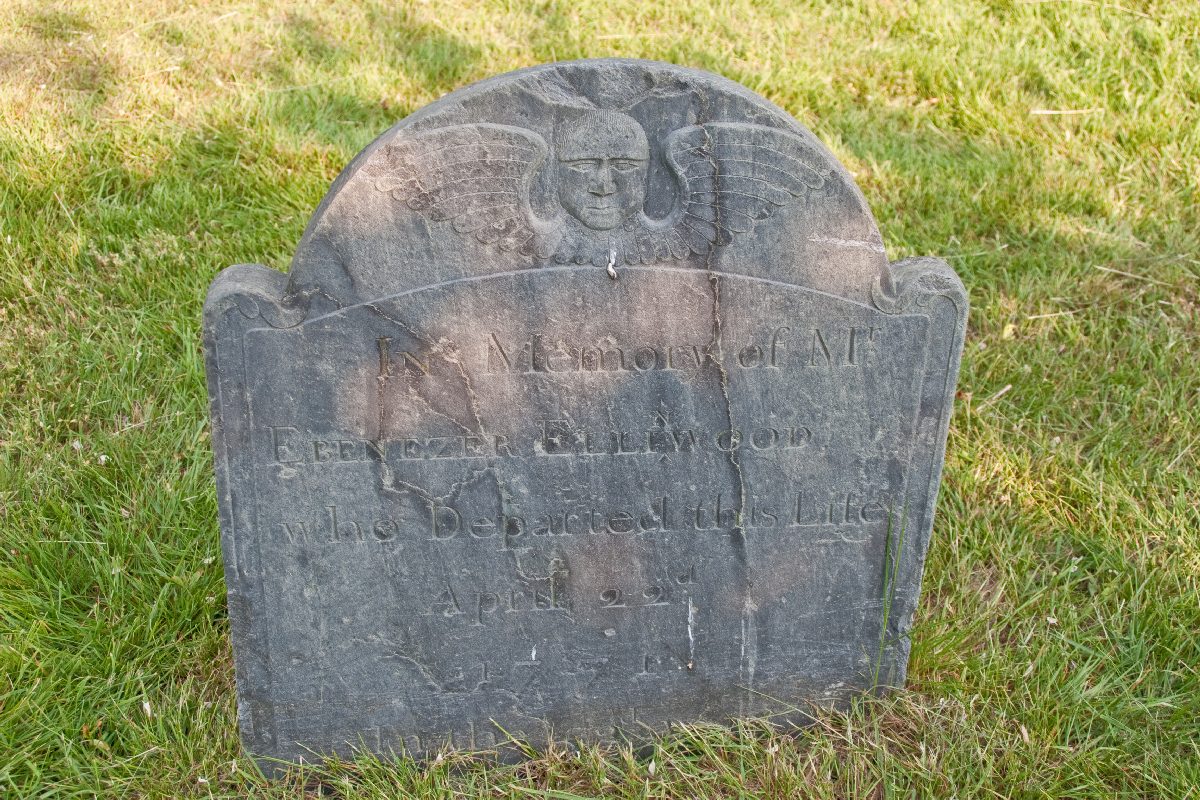
Grave of Ebenezer Ellingwood 
While neither of these are in my direct line of ancestors, they are close relatives of my many times great-grandparents and it is likely that they had contact with each other. I can't help but wonder what others in the family thought about slavery, equality, and the humanity of native and African people. 


http://www.celebrateboston.com/disasters/smallpox-epidemics.htm
http://dougsinclairsarchives.com/ellingwood/ebenezerellinwood.htm


Rev. John Maverick (father of Samuel) - 12th great-grandfather
Moses Maverick (brother of Samuel) - 11th great-grandfather
Abigail Maverick - 10th great-grandmother
Martha Ward - 9th great-grandmother
Martha Tuttle/Tuthill - 8th great-grandmother
Martha Haskell - 7th great-grandmother
Ruth Safford - 6th great-grandmother
Martha Haskell - 5th great-grandmother
Sally Houghton - 4th great-grandmother
Florilla Dunham - 3rd great-grandmother
Nina King Ellingwood - 2nd great-grandmother
Annie Florilla Gibbs - great-grandmother
Fern Lyndell Cotton - grandmother


Ebenezer Ellingwood (father of Ebenezer Jr) - 7th great-grandfather
Joseph Ellingwood (brother of Ebenezer Jr) - 6th great-grandfather
John Ellingwood - 5th great-grandfather
John Ellingwood Jr - 4th great-grandfather
Asa Freeman Ellingwood - 3rd great-grandfather & husband of Florilla Dunham (above)