Showing posts with label ancestry. Show all posts

Sunday, September 14, 2014

52 Ancestors #34 - Humphrey Atherson's Quaker Curse?

First published on March 16, 2012 ~
Humphrey Atherton, my 9th Great Grandfather, was a prominent man in the Massachusetts Bay Colony. He became assistant governor and in that capacity he was part of the prosecution and execution of Quakers who had been banished from the colony by law. Sources provide modern researchers with two Quaker trials associated with Humphrey Atherton. I started researching because I struck by the unusual manner of death described in accounts online. 

Humphrey Atherton died September 16th (or 17th), 1661 after being thrown from his horse. Various accounts list the reason for the fall as either the horse tripped over a cow or was startled by a cow. Either way he suffered a serious head injury that resulted in his death. Wikipedia provided a starting point for my research and provided most of the pictures and Google books was a great resource for checking original sources. 

First Case: 
Mary Dyer was a Quaker who was executed in 1660 for repeatedly returning to the Massachusetts Bay Colony in violation of a law banning Quakers. Mary and her husband, William, were supporters of Anne Hutchinson (not a Quaker) and followed her to the Colony of Rhode Island and Providence Plantations. It is unclear why Mary returned to Massachusetts Bay Colony as a Quaker. She was in the company of William Robinson and Marmaduke Stevenson. They were caught once and warned that the punishment for getting caught again would be severe. Stevenson said he felt called and sent by God to be in Boston and both he and Mary returned and were soon jailed. Mary refused pleas of her family to recant. She was spared from gallows by a last minute reprieve on October 27, 1659. Stevenson was not so fortunate and was hanged. Still Mary chose to disobey orders and returned to Boston again in May of 1660. This time there was no reprieve and she was hanged. Humphrey Atherton was on the court that sentenced her and present at her execution. "General Atherton cracked the silence, 'She hangs there like a flag,' he said." (Plimpton, p.188)

Wenlock Christison was another Quaker who repeatedly returned to Massachusetts despite banishment. He was put on trial in May 1661 and sentenced to death. However, the law was changed before his sentence was carried out. Several sources state that Wenlock Christison warned Atherton that he would soon face God's judgment. 

"Wenlock Christison Defying the Court"
http://digitalgallery.nypl.org/nypldigital/id?1213844

Joseph Besse, Quaker author, provides the following account of Atherton's death: 
"Humfray Adderton, who at the trial of Wenlock Christison, did, as it were, bid defiance to Heaven, by saying to Wenlock, 'You pronounce Woes and Judgements, and those that are gone before you pronounced Woes and Judgements; but the Judgements of the Lord God are not upon us yet,' was suddenly surprised: having been, on a certain day, exercising his men with much pomp and ostentation, he was returning home in the evening, near the place where they usually loosed the Quakers from the cart, after they had whipped them, his horse, suddenly affrighted, threw him with such violence, that he instantly died; his eyes being dashed out of his head, and his brains coming out of his nose, his tongue hanging out at his mouth, and the blood running out at his ears: Being taken up and brought into the Courthouse, the place where he had been active in sentencing the innocent to death, his blood ran through the floor, exhibiting to the spectators a shocking instance of the Divine vengeance against a daring and hardened persecutor; that made a fearful example of that divine judgment, which, when forewarned of, he had openly despised, and treated with disdain.' "  (Besse, Woodward)

Henry Wadsworth Longfellow includes the following in the final scene of his play, John Endicott. Governor Endicott is speaking to Richard Bellingham and asks if it is true that Humphrey Atherton is dead. Bellingham replies. "His horse took fright, and threw him to the ground, so that his brains were dashed about the street." Endicott's response is "I am not superstitious, Bellingham, and yet I tremble lest it may have been a judgment on him." 

So was it God's judgment for Atherton's persecution of the Quakers that caused his death? Was it a clumsy horse? Was it a wayward cow? Whichever scenario you prefer to believe, it is an unusual death. 

Humphrey Atherton is buried in the Dorchester Old North Burying Place in Boston. 

Descent:
Humphrey Atherton & Mary 
Mary Atherton & William Billings
Mary Billings & John Whiting
Jemima Whiting & Jonathan Wight
Joseph Wight & Abigail Ware
Abigail Wight & Enoch Spurr
Roxanna Spurr & Edward Stanley
Mary Frances Stanley & Augustus Mellen Carter
Edward M. Carter & Fannie Mae Capen
T. Richard Carter

Sources:

Longfellow, Henry Wadsworth. John Endicott. Act V Scene III.

The following were accessed using Google Books: 
Woodward, Harlow Elliot. Epitaphs from the Old Burying Ground in Dorchester. Boston Highlands. 1869. p.6 

Mary Dyer: biography of a rebel Quaker by Ruth Talbot Plimpton p.188.

Besse, Joseph. William Sewel. The history of the rise, increase, and progress of the Christian people called Quakers: intermixed with several remarkable occurrences. J. Sowle. 1722. p. 343


Saturday, October 26, 2013

Ancestry DNA Update

Ancestry recently updated the DNA profiles of their customers. I've seen a number of postings on Facebook and on blogs about how things changed. I checked mine yesterday. Originally, my estimate was very generic and boring, but not unexpected. My own research reveals that virtually all of my ancestors came from England with a sprinkling from Ireland, Scotland, Wales, and a lone French Huguenot. 


I was hoping to at least reveal a little bit of biodiversity from the Viking, Germanic, or Norman invasions. When the update was released, Ireland was separated from Great Britain and more detail was added. This did, indeed, reveal some Scandinavian, Western European, and Irish ancestry. What was completely unexpected was the 5% from the Iberian Peninsula. The site says that Iberian DNA is common among those with British ancestry. Here are my updated results. 


I am just beginning to understand some of the uses of DNA in genealogy. I do know that the more information that is put into the system, the more refined the results will be. I like the fact that Ancestry.com will continue to refine my results without charging more money for each update. I was a bit disappointed that the original results were not more specific but this is more interesting and reflects what I know about my origins. I look forward to learning more and more about DNA and how to interpret and use DNA results in genealogy. 

Tuesday, July 16, 2013

Tuesday's Tip - One Piece of Advice

I was recently contacted by a former student and asked for advice about how to start researching his family history. He had one line that his grandmother had researched back for thirteen generations but many other lines with brick walls. He is using Ancestry.com. I gave him my abbreviated version to get him started and I know there are many, many resources out there that describe the process but I was wondering this...

  1. What was the biggest mistake you made when you started? 
  2. What is one thing you wish someone told you when you were starting out? 
  3. What is your most helpful resource today? 
  4. What is one piece of advice that helps you keep your enthusiasm going when you feel lost and frustrated? 


My answers - if you are willing to contribute to a follow-up post, please leave your answers in the comments and if you blog about your genealogy, leave me a link so I can include it in the future post. 

  1. Biggest mistake - not keeping track of/documenting sources of information
  2. I wish I knew - how poorly documented and inaccurate many of the online family trees are
  3. Most helpful resource - probably Dropbox - it's where I save images of the documents I find online to source my family tree. It's important to source but it's taken awhile to find a way to keep electronic images so I can easily go back to them. I create a surname folder and then subfolders for each family group and file census records, relevant images from NEHGS etc. in the appropriate folder. A very close second is the online geneabloggers community. I encouraged him to start a blog. 
  4. One piece of advice - keep two trees. One that is carefully documented and one that is undocumented or partially documented to be used a clues for future research. When one line gets you down, switch to another so you get some success to keep you motivated. 


I don't believe that genealogy is the realm of the retired. I know plenty of young people like this 21 year old who are very interested and excited by exploring their ancestry. It's a matter of finding the time in their busy schedules and encouragement. Like most of us, they will make rookie mistakes but they will get better with practice. 


Monday, June 10, 2013

Genealogy & High School Students


Once again we are at the end of the school year and some of my students have chosen to research their ancestry as their final project. Each year, I get better at structuring the project for student success. The AP US exam was later this year than in the past and students did not have as much time to work on their projects but still achieved exciting results. Some highlights from this year include:

  • A girl who got so caught up in her findings that she exclaimed, "This is so much fun! I spent two hours last night because I got so caught up in researching." She found many documents including her great-grandmother's immigration record. Her great-grandmother arrived on the Mauritania from Germany. The student thought it was really cool that she found a picture of the ship. Then I told her it was a sister ship to the Lusitania - that we learned about when studying the events leading to the First World War. It was fun to see her connect her family to the history we studied during the year. Students are required to find a minimum of 10 records to document their parents, grandparents, and great-grandparents. 
  • A girl who knew her family heritage was Italian but had no idea who the immigrant ancestor was or when he arrived in the United States. I was able to help her locate her great-grandfather's immigration record and we also found she had a great-grandmother from Quebec - something she did not know. She found numerous records to show how her family moved around from Vermont to Massachusetts to Maine. I have encouraged, and most have included, maps to show places their family has lived over time. 
  • A boy who got a large packet of information from his grandmother. I love that this project opens the conversations between the generations. Many have never discussed the family with their grandparents. The project also includes a mandatory interview with a grandparent or if that is not possible, with someone who can share what they know about the life of a grandparent. 
Photos of people or of family heirlooms, gravestones, family homes are also highly encouraged. Most students haven't thought of including pictures of things in telling their family's story. They begin to realize that the things can help tell the story of the lives of their ancestors. 
Over the past few years, I've found success in encouraging students to go where the research takes them. Many times school-based family history projects are all about filling in the tree and finding pictures of the people in the tree. I allow my students to focus on one line or multiple lines. Many ask how many generations they need to find. I tell them I would rather have them do it carefully with good research and documentation even if they only get a few generations done. The flexibility to follow the evidence has made it a more fulfilling experience for them. They don't get stressed out about finding "enough" ancestors and focus on finding the stories and learning about the lives of the ancestors they can document. 

Monday, February 25, 2013

Lost & Found

Over the years of working on my genealogy I have lost and found more ancestors than I can count. Think of your clothes over the past decade. You find something that you think is amazing and awesome only to discover later that it doesn't really fit or isn't quite right and you discard it. Watching an ad for ancestry.com makes doing genealogical research seem so easy; just type in a few details and up pops a leaf that leads to fascinating facts about your ancestors. Unfortunately, real research is not that easy. Oh, you can just click on those leaves and add all sorts of things to your family tree but do so at your own peril - it's a bit like buying clothes on impulse. There is a lot of sloppy research and erroneous information out there. I am finding an increasing number of hints where the record does not even have the same name as the person for whom it is being suggested. The family trees that others have done are often equally misleading and not all sources/records are created equal. 

This is not, however, a rant about the horror of amateur family historians or an attempt to discourage you from starting your family tree. Quite the opposite. I remember the thrill of clicking and adding relatives when I first started. There were no shaking leaves then but still plenty of information that was easy to find. If it had been more difficult, I might have gotten frustrated and given up. I have seen my students experience that same thrill. I admit that I am not a purist. I jump around from branch to branch and work on whatever part of my tree captures my attention in that moment. I do not work methodically on a single line until it is done. 

However, I have learned to temper my enthusiasm with a healthy dose of skepticism about what I find online. I use trees of other members as starting points for research and look for records to back up what is recorded. I have made my trees private after being ripped into several times by those who believe no information should be recorded until it is completely verified. 

Finding ancestors is like being a private detective. You have to follow the clues and collect enough evidence to make your case solid. You will receive lots of tips and most of them turn out to be irrelevant and misleading but with persistance, you can find reliable information and solve the mystery. Sometimes it's a preponderance of circumstantial evidence and that's the best you can do.

Assembling ancestors into a family tree is like putting together a jigsaw puzzle. Sometimes a piece seems to fit but later you notice the subtle clues that show it isn't quite right and you begin again to find the piece that goes in that spot. Each piece you correctly identify and fit into place goes into making the larger family picture come to life. 


I do make errors but even when I have to lop off a branch from the tree because I've made a mistake, I always learn something and often find interesting stories of people and history. So get in there and start looking. Use the easy hints to get some traction but go back and evaluate with more care. I suggest using two trees - one for leads and possibilities and one that is as carefully documented as you can make it. 

Wednesday, October 24, 2012

My DNA Profile

Ancestry.com started a new DNA testing program that is open by invitation only while it is in Beta testing. Because I've been a customer for quite awhile, I received an email invitation to take part in this program and they were offering a significant discount to those who accepted. Having seen the testing done on Finding Your Roots, the PBS show about celebrity genealogy, I was intrigued to find out what my DNA would say about my ancestors. My own research has shown that most of my ancestors from both my father's and my mother's families came from the British Isles to the American colonies in the early 1600s. While I figured I would have predominantly British ancestry, I was still surprised when the results came back as 100% British Isles.  No traces of intermingling genes with marauding Vikings or Barbarians, no evidence of dalliances with Frenchmen, Germans, or Italians...I seem to be about as white, Anglo-Saxon, Protestant as it is possible for one to be. A bit boring to some but it does make tracing ancestors a bit easier. 
It does seem to explain my love for the British Isles. And why it is that I felt so comfortable and at home whenever I've visited England or Scotland. So I'll continue to embrace my ancestors and the culture I love. I'll find diversity in friends to make up for the lack of diversity in my genes. I had a great time last year helping my students trace their family trees to Italy, Scandinavia, and Germany. 

Monday, June 25, 2012

It's All Relative

I was absent from blogging for about a month - from mid-May to mid-June. I was, however, heavily involved in research. I had a group of students who wanted to find out about their families and I was helping them rather than doing my own research and writing. I have done this with students before but this time I tried to give emphasis to the story aspect of family history.

Some of my observations:
  • Nothing warms my heart more than to see a student whip out his cell phone and call grandma to find out information and observe an extended meaningful conversation between them. This is an approved use of a cell phone in my class!
  • In today's mobile society, families are often spread out and don't have (or take) the time to talk about their lives and pass on family stories. I'm certain many of my students have not had more than a superficial conversation with their grandparents. It makes me sad because I know a lot of stories from my grandparents' lives. 
  • Everyone can find information and stories. It was great to see students who thought there was nothing interesting in their family, find something special. Even ordinary people have interesting stories. The internet makes it easy to find information if you have some basic information on ancestors who lived in the early 20th century. Almost everyone can get that information on at least one branch of their family. 
Some things my students found out
  • My father was raised as a Mormon
  • There were two Pillsbury families: "One brother founded the baking company and I'm descended from the other one"
  • There's a historic house in Topsham that belonged to one of my ancestors
  • My (how ever many) times great-grandfather designed the logo for Humpty Dumpty potato chips
  • My mother's ancestor and my father's ancestor both fought for the Union at the same battle in the Civil War in different regiments and from different states.
  • My Civil War ancestor survived one of the bloodiest battles of the war and then got a land grant in Maine where he broke his back in a fall while building his home. 
  • Hey, I'm related to Ms. Carter! 
They discovered accused witches, artists, inventors, politicians and writers. Their origins were very diverse: Canada, Germany, Austria, Sweden, Norway, Italy, England, Ireland, Scotland and more that I can't remember. 

Monday, April 23, 2012

Happy St. George's Day!

St. George is the patron saint of England and St. George's Day is celebrated on April 23rd. In honor of all my British ancestors, I present a few facts about St. George. It's also my mom's birthday so "Happy Birthday, Mom!" 


St. George wasn't English and there is so much mythology surrounding him that it is hard to distinguish actual facts. The best guess is that St. George was born in modern-day Turkey in the 3rd century. The story is that his parents were Christian and after his father died, George's mother moved back to her native Palestine, taking George with her. George became a soldier in the Roman army. Emperor Docletian began a campaign against the Christians at the beginning of the 4th century. Legend has it that George resigned from the army and tore up the Emperor's order against Christians in protest. George was thrown in prison and tortured but he refused to deny his faith. Eventually he was dragged through the streets and beheaded. 


The story of St. George slaying a dragon originated in the 15th century. As entertaining as it is, it must be relegated to the realm of mythology. 
File:Stgeorge-dragon.jpg


St. George began to be linked to England during the Crusades. One story that is recorded in stone over the south door of a church at Fordington, Dorset, tells of his miraculous appearance and leading crusaders into battle. When Edward III founded the Order of the Garter, he assigned St. George to be its patron saint. St. George's Chapel at Windsor Castle was built by Edward IV and Henry VII as the chapel of the order. Since that time St. George has been regarded as a special protector of the English. 


St. George Chapel Windsor, England

The flag of St. George is a red cross on a white background and is incorporated into the Union Jack. 


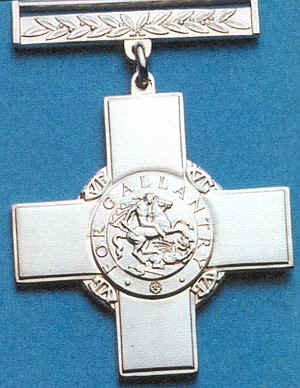
In 1940 King George VI inaugurated the George Cross for "acts of the greatest heroism or of the most conspicuous courage in circumstances of extreme danger." The award is usually awarded to civilians. It depicts St. George slaying the dragon on a silver cross. 
Info source:
http://www.bbc.co.uk/religion/religions/christianity/saints/george_1.shtml

Image sources:
http://en.m.wikipedia.org/wiki/St._George_and_the_Dragon
http://www.google.com/imgres?
http://www.topnews.in/george-cross-theft-case-takes-another-turn-2241432
http://www.inetours.com/England/Windsor/photos/St-Georges_9927.html
http://fandangman.blogspot.com/2010/06/its-all-flags.html
http://www.ibiblio.org/wm/paint/auth/altichiero/

Saturday, April 21, 2012

Surname Saturday - Fun With Wordle

This idea came from a tweet I read today. I can't remember who issued the challenge to do something diffeent and post a wordle but here is mine. These are the surnames in my direct line. Wordle makes words bigger depending on the number of times the word occurs. You can play around with colors, fonts and layouts. Sometime I'll get all the first names done too but this took quite awhile to organize. I think I want to update it every year to see how it changes as my research progresses.

Another view that's more jumbled - just for fun


Sunday, April 8, 2012

Turn the Page

Genealogy can be an adventure and sometimes a lesson in frustration. Today I was going through records I found for my great-grandparents. I looked at the marriage record on ancestry.com and noticed that I could go to the next record in the batch. So being curious, I clicked to advance the page. Well, the next page was actually the back of the marriage record. I didn't even know it had a back side! On the back were the names of the groom's and bride's parents. The name of my great-grandfather's mother did not match what I thought I knew. Oops!! It turns out that my great-great-grandfather was married not twice but three times. Just like the commercial for ancestry.com. I thought the mother of his children was Lillie Esther Shaw but she was actually wife number 2. Wife number 1 was Lizzie M. Philbrick - thus solving a family mystery of the identity of "Grammie Philbrick"  - a name my father's generation heard often but didn't know to whom it referred. It solved the mystery of Civil War enlistment papers, for a Benjamin Philbrick, in the possession of one of my cousins. And of course, it has sent me on a new hunt for ancestors - a new adventure. I'd done a pretty good job of tracking down the ancestors of Lillie Shaw but they are not actually related not me...oh well. The lesson I am taking from this is to TURN THE PAGE. You never know what you might find. 


Francis L. Cotton & Lizzie M. Philbrick
Ray Everett Cotton & Annie Florilla Gibbs
Fern Lyndell Cotton - my grandmother


Saturday, April 7, 2012

Why You Should Be a Geneablogger Too

I have always been interested in my family's history. I started researching my genealogy when I had a hip replacement and had limited mobility during the summer of 2004 (or 2005 - I'm not exactly sure). I was not very good at it when I started, went down more than a few false trails and gathered a lot of undocumented and extraneous information. I've been pecking away at documentation and attempting to clean up my family tree and break through brick walls ever since. 

Last summer I found a Facebook page dedicated to the descendants of Asa Freeman and Florilla (Dunham) Ellingwood - my 3rd great-grandparents on my father's side. I connected with a third cousin, Bill West, a retired bookseller from Abington, Massachusetts who writes a blog called West in New England. After reading his posts and seeing how others were sharing their genealogy through blogs, I became inspired to create my own. So in late February, I took the plunge and created my first post. It's not always easy to find the time to write but I have found a few things that have helped. Most importantly when I don't have time to write an entire post, I put down my ideas and save it as a draft and come back to it later. I have at least as many drafts as I have posts so I always have something to write about. My goal is at least 2 posts a week and in March I was able to post 16 times! I can't guarantee that pace will sustain itself so I'm keeping my goal at 2 posts a week for the rest of 2012. 


So why should you give blogging a try?
  • In six weeks, I have made more connections with people who can help me than I've made in six years. 
  • I've found stories about my ancestors and the places they lived. These make family history more meaningful than mere names on a page.  
  • As someone who loves history, I've expanded and enriched my knowledge - giving me more to share with my students and hopefully making my teaching more relevant and interesting. 
  • I am learning more about where and how to research. 
  • And...I've gotten a little ego boost from those who have commented on the blog or to me in person and told me how much they enjoy the stories I've shared. 
There is a great community out there of geneabloggers. Head on over to www.geneabloggers.com for some inspiration and tips on how to get started. It is a great resource with links to a wide variety of blogs that can be searched by category. Several sites linked there provide daily or weekly writing prompts for those times you have writer's block. So what are you waiting for? Start telling the story of your family and reap the rewards! 

Sunday, March 25, 2012

When Your Family Tree Doesn't Fork...

 In the U.S. we have a natural horror of marrying a cousin. You'll end up with deformed children!! Well, guess what? It's not even close to true! When you start doing genealogy, you realize how quickly the number of individual people grow as you progress through the generations - 2 parents, 4 grandparents, 8 great- grandparents etc. Ten generations brings one to the potential for 1024 direct ancestors and if you go back to the time of Charlemagne it's an estimated 281 trillion! Have that many individuals really existed since the beginning of mankind? 


Well, the short answer is no. We can't have more ancestors in a generation than the total known population of the earth at the time. Therefore it is estimated that 80 percent of marriages have been between first or second cousins and 100 percent of marriages will find a connection if you go back far enough. The cool thing about this reality is that you are very likely to find connections to rich, famous and historically significant figures if your ancestors came from the same general area as theirs during colonial times (New England for me). In fact, I am a 10th cousin of Barack Obama on his mother's side, the Dunhams. 


If you're researching your family tree back to colonial times or earlier, you will find many, many others who are also searching for the same families and therefore your cousins. Besides the fact that it is statistically impossible to have 281 trillion European ancestors in your 30th generation, one needs to remember the lack of mobility people had prior to the 20th century. In previous centuries, most people were born, lived, and died in the same town. Then there are factors such as the inter-marrying of the European royal families. All of these factors lead to more cousins than distinct individuals in your family tree. I can't say it still doesn't freak me out a bit when I see it in my own family tree but understanding the mathematical, sociological and scientific realities helps. I found the following web sites interesting.


"Facts about Cousin Marriage " Cousin Marriage Resources. 24 Mar. 2012. Web. 24 Mar. 2012. <http://www.cousincouples.com/?page=facts>. 

  • We are all cousins - no two people are more distantly related than 50th cousins. 
  • Twenty-six states and all European countries allow first cousins to marry. It is also legal in Canada and Mexico. 
  • Leviticus 18 lists all forbidden sexual relationships. Cousin relationships are not included.
  • Albert Einstein & Charles Darwin married their first cousins.
  • Second cousins have little, if any increased chance of having children with birth defects, according to the book "Clinical Genetics Handbook." The National Society of Genetic Counselors estimated the increased risk for first cousins is between 1.7 to 2.8 percent, or about the same as any woman over 40 years of age. 

R., Danielle. "10 Famous People Who Married Their Cousins." Listverse. Ultimate Listverse Top 10 Lists, 20 July 2008. Web. 24 Mar. 2012. <http://listverse.com/2008/07/20/10-famous-people-who-married-their-cousins/>. 

  • Jesse James & Zerelda "Zee" Mimms - 1st cousins
  • Franklin Delano Roosevelt & Anna Eleanor Roosevelt - 5th cousins
  • Johann Sebastian Bach & Maria Barbara Bach - 2nd cousins
  • H.G. Wells & Isabel Mary Wells - 1st cousins
  • Thomas Jefferson & Martha Wayles Skelton Jefferson - 3rd cousins
  • Albert Einstein & Elsa - 2nd cousins
  • Charles Darwin & Emma Wedgwood - 1st cousins
  • Edgar Allan Poe & Virginia Clemm - 1st cousins; she was 7 when he moved into her home - her parents were his aunt and uncle & she was 13 when they married
  • Jery Lee Lewis & Myra Gale Brown - she was 13 when they married
  • Rudy Guiliani & Regina Peruggi - 2nd cousins
For more information, search "diamond theory of genealogy" 

Saturday, March 17, 2012

My Irish Roots


Happy St. Patrick's Day!
(Originally published on March 17, 2012)
Most of my family lines go back to immigrants who came to New England in the 1600s. However, I have one 3X great-grandmother who came from Ireland, probably in the 1820s according to census records. Eva Bean included John Williamson among the veterans of the War of 1812 but that doesn't make sense with the census records. The family is not in the 1820 census and according to later census records Rebecca was born about 1816 in Ireland. If the family was here in time for the War of 1812, Rebecca would have been born in the U.S. In the 1830 Bethel census John Williamson is the head of the household and there are two females - one between 30 & 40 and one between 15 & 20.  These facts line up with the dates passed down through the family for John, his wife Ann, and his daughter, Rebecca. 

Williamson is not a very Irish sounding name so I wonder if they were English and moved to Manorhamilton somewhere along the way. I also would love to find out why they left Ireland. Regardless of the exact date they came, it is clear they were in Bethel well before the potato famine in Ireland. 
Manorhamilton, Ireland


The family came from Manorhamilton, named for Sir Frederick Hamilton who was granted the land for his services in the European wars of the 17th century. The town was called Clonmullen and in the hands of the O'Roarke clan prior to its being granted to Sir Frederick. Manorhamilton Castle, built by Sir Frederick was burned to the ground in 1652 by the native Irish. This act appears to have been provoked by Hamilton’s cruel treatment of prisoners and his burning of Sligo town.  Here is a sketch of the castle before the fire and three pictures of the castle ruins. 


In searching Irish records, I can see general information without paying and I can find several passenger lists with Williamsons on board but none of the dates and ages of the passengers line up with my ancestors. I'm unwilling at this point to pay about $20 just to look at one record. Hopefully some day I will be able to go and look through records myself. For now, I will have to be content with what I know about their time in the United States. Williamson is not a very Irish sounding name so I wonder if they were English and moved to Manorhamilton somewhere along the way. I also would love to find out why they left Ireland. Regardless of the exact date they came, it is clear they were in Bethel well before the potato famine in Ireland. 

In honor of St. Patrick's Day and through the magic of the internet here are two videos of Manorhamilton.

St. Patrick's Day Parade - Manorhamilton, Leitrim, Ireland 2009

Youtube - Manorhamilton


Sources:
http://www.leitrimtourism.com/Places-to-Visit/Places-to-Visit-(1)/Manorhamilton-Castle.aspx

http://www.thebetheljournals.info/Biography/Williamson_Journal.htm#photos
Wikipedia - Manorhamilton

Lapham, Howard B. "History of Bethel:." Google Books. Google.com. Web. 03 Mar. 2012. <http://books.google.com/ebooks/reader?id=4vUgAQAAMAAJ>.

Monday, March 12, 2012

Strong Women Part 2

**Update - It's 2016 and today my grandmother is 96 years young! Still living in her own apartment, with some assistance from family and other caregivers. Happy Birthday! 

Today I would like to wish a happy 92nd birthday to my grandmother, Linona "Peggy" Blake. She was born in 1920, the daughter of Estes and Eva Yates. She was the fourth of eight children and the second girl. She has outlived all her siblings except the youngest one. She married my grandfather, Clayton Blake in Bethel, Maine. Together they raised three daughters, Myrna, Kaye, and Loretta. They lived in the part of Bethel known as the "Steam Mill" because that was the most well-known local feature. My mother told me they lived across from the mill and that both my grandparents worked there while she was growing up. By the time my memories start, my grandparents were spending summers working at the Balsams Resort in New Hampshire during the summers and at a resort in Pompano Beach, Florida during the winters. During the shoulder seasons, they had a little cabin behind my great-grandparents' house. Grammie is a wonderful cook and she was the pastry chef at these resorts.  My mother drove a school bus and my sister and I had to ride the high school run and the elementary run in the mornings. When Grammie was home, my mother would let us off on her way out to pick up the high school students and pick us up for the elementary run. Grammie would make us a big breakfast. I remember having a pancake eating contest with my grandfather one morning and my grandmother getting upset with him when he wouldn't let me win. She was worried I would get sick at school from eating too many pancakes. I think we finally called it a tie. 

I admire her very much. She worked hard her entire life. She is a very positive person and loves to dance and sing. I remember her always singing while she worked around the house. Two summers ago we had a party for her 90th birthday. She wore a bright pink dress (see picture above) and loved being the center of attention. She danced most of the afternoon. She continues to be active in the Grange and loves to socialize. She painted beautiful landscapes and sewed clothes for herself and others. She had to give up those activities when her eye sight got too weak. Spending time with her yesterday reminded me how lucky I am to still have a living grandparent. 

Happy Birthday, Grammie! 

Sunday, March 11, 2012

Unsolved Murder

My 10th Great Grandmother was murdered in New Hampshire in May or June of 1648. Her name was Hannah (or Annah) Willix. She was traveling from Dover to Exeter when she was attacked, robbed and her body "flung" into the river. I found a document online called "New Hampshire Homicides 1630-1774" that contains this information: Hannah "was founde in the [Piscataqua] River dead; her necke broken, her tounge black and swollen out of her mouth & the bloud settled in her face, the privy partes swolne &c as if she had been muche abused &c." 


It is not known whether her murderer was ever caught. Her husband Balthasar did file a breach of contract suit against Robert Hithersay "for raising an evil report of his deceased wife, and for breach of promise in carrying his wife to Oyster River in a canoe and not bringing her in a canoe again." Hithersay seems to have been a wandering character whom Balthasar suspected of harming his wife. Hithersay and Balthasar Willix had cross suits for defamation. I could not find any records describing the resolution of this case. The Oyster River is speculation from some who interpreted the O.R. to mean Oyster River.  After her death, Balthasar moved to Salisbury, Massachusetts and married a widow named Mary Hawksworth. He is called a man of "more than ordinary education" by Bell. I will definitely continue looking for information on this crime. 

In 1996 a book was loosely based on this case - The Strange Death of Mistress Coffin by Richard Begiebing. 

Balthasar Willix & Hannah/Annah
Hazelelponi Willix & John Gee
Hannah/Annah Gee & Samuel Hodgkins
Jonathan Hodgkins & Mary Stockbridge
Rachel Hodgkins & William Moody
Elizabeth Moody & Samuel Ackley
William Ackley & Deborah Capen
Sarah Ackley & John Abbott
Mary Jane Abbott & Edward Capen
Fannie Capen & Edward M. Carter
T. Richard Carter & F. Lyndell Cotton


Sources: 
NEHGR Vol. 50 p. 46-47
History of the town of Exeter, New Hampshire by C.H. Bell

Balthasar and Hazelelponi!

Balthasar and Hazelelponi??? What odd names! Balthasar Willix is my 10th Great Grandfather. Balthasar is one of the names of the three magi along with Caspar and Melchior. While looking for references to the name I learned Saint Balthasar is the patron saint of playing card manufacturers...seriously? There is a patron saint of playing card manufacturers! He is also the patron saint of those with epilepsy and sawyers. That's a diverse group! 


Balthasar's daughter, Hazelelponi Willix is my 9th Great Grandmother. So where does the name Hazelelponi come from? Like many names of the era (she was born abt 1636), it comes from the Bible. First Chronicles 4:3: "And these were of the father Etam: Jezreel and Ishma and Idbash: and the name of their sister was Hazelelponi " The meanings vary according to source. Some think it might be the name of a clan or town rather than a personal name. Its meaning is also varied according to source but the overall consensus is that it refers to shade or shadow over a face. "The Shadow Looking at Me" or "Give Shade, Thou Who Turnest to Me" 


So what leads one to name a daughter Hazelelponi? Hazelelponi receives only passing reference in the Bible so what made them pick this obscure name?  Did her parents want her to stand out in a sea of Marys, Sarahs, Hannahs, and Rebeccas? Her sisters were Anna or Hannah and Susanna. Hazelelponi married first John Gee and second Obadiah Wood. One of her daughters was named Hazelelponi but she named her other daughters common names; Mary, Martha, Hannah. Hazelelponi Willix Gee Wood is buried in the Old North Burying Ground in Ipswich, MA. 

These images come from ancestry.com - tree of Joan Jordan.


Balthasar's wife and Hazelelponi's mother was murdered and thrown in the Oyster River and I will write about that in a future post. 


Other posts on unusual names:  Soranus Shaw
Balthasar Willix & Hannah/Annah
Hazelelponi Willix & John Gee
Hannah/Annah Gee & Samuel Hodgkins
Jonathan Hodgkins & Mary Stockbridge
Rachel Hodgkins & William Moody
Elizabeth Moody & Samuel Ackley
William Ackley & Deborah Capen
Sarah Ackley & John Abbott
Mary Jane Abbott & Edward Capen
Fannie Capen & Edward M. Carter
T. Richard Carter & F. Lyndell Cotton


http://www.thinkbabynames.com/meaning/1/Balthasar
http://saints.sqpn.com/saintb35.htm
http://bibleencyclopedia.com/hazzelelponi.htm
http://www.abarim-publications.com/Meaning/Hazelelponi.html#.T1zNNDGPng0
http://www.studylight.org/dic/hbd/view.cgi?number=T2633

Wednesday, March 7, 2012

Strong Women, Part 1

I am so lucky to have had wonderful strong female role models in my life. My great-aunts are two of those role models. 


Rebecca Williamson Carter Bailey - Aunt Becky was born in 1913. She graduated from college and got a master's degree. She spoke French and worked to keep that skill her entire life. She was always looking for opportunities to learn about the world and she and Uncle Bruce had a large library. She was an advocate of education and when she died she established a trust fund to help the children and grandchildren of her brothers get education or training beyond high school. 


Aunt Becky served as a WAVE in the Navy during World War II. She had a love of history and a keeper of family history and artifacts. She was very unconventional and a free-thinker. She got married in a red dress and she and Uncle Bruce never had any children. They lived very simply and for many years did not have indoor plumbing, electricity or a phone. She did have a huge wrap-around porch with hanging beds and hammocks which I loved to play on when I was a kid. The house was quite a way up in the woods and her nearest neighbors were out of sight and earshot. The view was magnificent! 


She was a wonderful aunt to her nephews and nieces and their children and grandchildren. Aunt Becky was tough as nails but very loving and caring. One of my visits with her when she was in her mid-eighties illustrates this well. She had been working around the farm when a barn door came off its rolling track and fell on her. She was less than 5 feet tall and weighed less than 100 pounds and as previously mentioned, in her eighties. She had broken and bruised some ribs but was quickly sent home from the hospital to recuperate. When my sister and I arrived for a visit she was propped up in a bed that had been set up in the dining room so she didn't have to go upstairs. We chatted about various things and she told us what happened. She said her thoughts while trapped under the door were "this would be a heck of way to die" and that motivated her to crawl out and get to her phone (family insisted she install one after Uncle Bruce died and she was there alone). She commented to us that "it's much better that this happened to me and not to one of you." We were very curious why she would say such a thing and her reply was that she didn't have to get up and go to work or take care of children. As we drove home we were laughing about her reasoning and how it was typical of her pragmatic view of the world.


Elizabeth Ayers Mason married my grandfather's brother, Stanley Carter. She was another college graduate in my family. This was fairly unusual for a woman born in 1907. She had a career as a social worker. Aunt Elizabeth was active in politics and interested in family history. She helped get the Bethel Historical Society started and hosted family reunions. She loved cats and I heard comments while I was growing up about the crazy cat lady who lived in West Bethel. I would just smile and say she was my aunt and she was not crazy; she was a very sweet lady. She did have about twenty cats at a time living with her after my uncle died. Most were dropped off by people who knew they would have a good home with her. She was ten years older than Uncle Stanley and close to fifty when they married so they had no children. Her cats were her children. She had all her cats spayed and neutered and they had regular check-ups. Her house was immaculate and the litter boxes were in the shed and cleaned daily so there was absolutely no odor. That's not an easy thing with that many cats. 


My best memories are of the Christmas parties Aunt Elizabeth had for me, my sister and my cousins, Becky, John and Nancy. They were elegant affairs. Everyone dressed up and she served tiny sandwiches with the crusts cut off and introduced us to types of bread and fillings we did not normally experience because they are usually reserved for adults at afternoon tea parties. There were fancy cookies and candies too. We ate off china plates with real silverware. There was classical music playing in the background. It was so sophisticated compared to our everyday lives. She treated us like adults and we adored her for it. Our gifts were often ceramic figurines, jewelry or music boxes - things our parents wouldn't buy for us because they didn't trust us not to break them immediately. I still have two pieces forty years later and neither has broken. We usually got a puzzle or toy too but what we treasured were the "grown-up" beautiful gifts. Mom made sure we used our best manners and wrote thank-you notes every year. When I was a young adult, I was living in West Bethel and Aunt Elizabeth walked daily and often passed our house. I would try to catch up with her every week and have a chat. She was a very interesting and active woman. 


I am very grateful to have had these two strong women as role models. They were adventurous and did things their own way without caring what other people thought of them. They were confident in their decisions and values and lived their lives with integrity and compassion. Both of them made a difference in the lives of others. They certainly made a difference in my life.


These pictures come from the Facebook page "I Grew Up in Bethel, Maine"  

Monday, March 5, 2012

Middle Intervale Meeting House and Common

 The Brick End House - In the Carter family for 7 generations! 
 Cemetery where many of my ancestors are buried from the 1790s to the 2000s. 


Center Meeting House and Common - Bethel | The Cultural Landscape Foundation: This was in the hands of my family for most of my childhood. The Middle Intervale Meetinghouse Society has done a phenomenal job restoring it and keeping it true to the time period. It is used for cultural events like concerts and quilt shows and of course, for the occasional wedding. The first Carter to come to Maine had a farm directly across the street and that farm is still in the family - run by my cousin, John and his partner Cynthia, who run a farm stand with fresh produce and organically raised beef. 

'via Blog this'