Showing posts with label England. Show all posts

Thursday, November 26, 2015

Giving Thanks

"Let supplication and Prayer and Thanksgiving bee made for all men...Remembrance of the good done to us...Confessing God to be the Author and giver of it...Cheerfulnesse, being glad of an occasion to praise him, and doing it gladly, with joy"  ~ Thomas Wilson

Thomas Wilson, minister at St. George of the Martyr Church in Canterbury never came to the colonies, but his ideas reflected the ideals of the early New England immigrants. 

Wilson was the author of A Christian Dictionarie. The dictionary has been used to provide clues regarding the Pilgrim's religious motives and it allows scholars to have some idea of how Pilgrims interpreted the Bible and used its words.The dictionary is listed in inventories of the estates of famous Pilgrims - William Bradford, Samuel Fuller and Myles Standish. Thomas Shingleton, John Kemble, and Robert Cushman were members of Wilson's congregation in Canterbury and later moved to Leiden and joined the Pilgrim Leiden Church. The Pilgrims were serious about studying the Bible and used a variety of books to help them in their studies. Wilson's dictionary was a best-seller and Dr. Ian Green called it the most popular Bible study aid. Given the importance of Bible study in the daily lives of the Pilgrims, this dictionary must have been highly regarded. 

So what does all of this have to do with Thanksgiving? Well, Wilson used his own definitions of everyday words and included quotes from the Scriptures to provide examples. Wilson's dictionary offered a religious definition of thanksgiving that included “An acknowledgement and confessing with gladnesse of the benefits and deliverances of God…to the praise of his Name" along with the quote that starts this post. The Pilgrims make repeated references to thanksgiving and it's pretty cool that one of my ancestors had such influence on their worship and daily lives. 


Robert Cushman (a member of the Pilgrim group in Leiden) called him "a very excellent preacher in Canterbury, who was both a lover of goodnesse and good men." 

Historian Peter Clark wrote the Thomas Wilson was "probably the most distinguished preacher in early Jacobean Kent [who preached] themes from middle-of-the-road Calvinism." 

10th Great-Grandfather
Rev. Thomas Wilson & Christian Ower
Theophilus Wilson & Elizabeth
Seaborn Wilson & David Fiske
Anna Fiske & Timothy Carter
Benjamin Carter & Sarah Stone
Timothy Carter & Sarah Walker
Timothy Carter & Frances Freeland
Elias M. Carter & Rebecca Williamson
Augustus M. Carter & Mary Frances Stanley
Edward M. Carter & Fannie May Capen
T. Richard Carter & F. Lyndell Cotton

Thursday, July 31, 2014

52 Ancestors #30 - Rev. Thomas Wilson

This is a reposting of my first blog entry. 

Thomas Wilson, author of A Christian Dictionarie


Thomas Wilson was the minister at St. George the Martyr Church in Canterbury from 1586 to 1622.  He was also a prebendary* of Canterbury Cathedral. He was buried in his parish on the 25th of January 1621-22. He was the first to attempt to compile a dictionary of the Bible in English. The first edition appeared in 1612 and a second in 1616. Other editions were published after his death. He also published other works including Commentarie upon the most divine Epistle to the Romans  and Christ's Farewell to Jerusalem. 

In attempting to find information about the church, I discovered an interesting but sad story. The church was destroyed during a bombing raid that devastated much of downtown Canterbury in World War II. All that remains is one tower. On the night of May 31st/June 1st, 1942 Canterbury was targeted as part of the so-called "Baedeker Raids."** This attack was likely a reprisal for an R.A.F. bomber raid on Cologne the night of May 30th. About one fifth of the City of Canterbury was destroyed that night as about 100 bombs and 6,000 incendiaries were dropped in two and a half hours. Fire damaged many properties because the majority of buildings were made of timber. Forty-three people died, forty were seriously injured and forty-one had less serious injuries. Follow-up attacks came on June 3rd and June 7th but these were not as destructive as the June 1st attack. 


The church had a long history. There is evidence of a church on the site from 1100 A.D. It had been enlarged, most recently in 1879 when another local church was closed and the two congregations merged. 

Quotes about Thomas Wilson:
Robert Cushman (a member of the Pilgrim group in Leiden) - "a very excellent preacher in Canterbury, who was both a lover of goodnesse and good men." 

Historian Peter Clark - "probably the most distinguished preacher in early Jacobean Kent [who preached] themes from middle-of-the-road Calvinism." 

*prebendary - an honor granted to senior priest in the Anglican Church usually awarded for long and dedicated service to the diocese. 
** Baedeker was the publisher of an English travel guide book reportedly used by the Germans to choose their non-military targets. They looked for cities with at least three stars for historical significance. 

10th Great-Grandfather
Rev. Thomas Wilson & Christian Ower
Theophilus Wilson & Elizabeth
Seaborn Wilson & David Fiske
Anna Fiske & Timothy Carter
Benjamin Carter & Sarah Stone
Timothy Carter & Sarah Walker
Timothy Carter & Frances Freeland
Elias M. Carter & Rebecca Williamson
Augustus M. Carter & Mary Frances Stanley
Edward M. Carter & Fannie May Capen
T. Richard Carter & F. Lyndell Cotton

Wednesday, June 26, 2013

Imprisoned in the Tower of London

Tower of London

Edward Gove was an early inhabitant of New Hampshire. About 1655, he moved from Massachusetts to Hampton, N.H. There he married Hannah Partridge, not Hannah Titcomb as seen in some sources. Proof of her identity is established in the New England Historical and Genealogical Register, Vol. 146, p. 15. Edward and Hannah lived on their farm and raised a large family - thirteen children, although not all survived to adulthood.

In 1682, Gov. Cranfield became the third royal governor of New Hampshire. Two descriptions of Cranfield come from historians Charles Bell, who called him "a needy, arbitrary and unscrupulous man" and Joseph Dow, who described him as "a man as unprincipled and as greedy of gain as the King himself." He after repeatedly butting heads with the colony's eleven member assembly, he dissolved it completely. This prompted an uprising that is sometimes called Gove's Rebellion. It was really more like a drunken and disorderly evening than a rebellion. Led by a trumpeter, Gove and some like-minded local men armed with pistols and swords "raised a ruckus" and were quickly arrested and then released. They expected that to be the end of it. Gov. Cranfield seemed to have other ideas and had them re-arrested and put on trial for high treason. Two weeks later, at the trial, most of the men were sent home but Edward Gove was found guilty...and the sentence for high treason was death! And what a gruesome sentence it was!

The sentence from Judge Richard Waldern:
"You Edward Gove shall be drawn on a hedge to ye place of Execution and there you shall be hanged by ye neck, and while yet living be cut down and cast upon ye ground, and your bowels shall be taken out of your belly, and your privy members cut off and burnt while you are yet alive, your head shall be cut off, and your body divided into four parts, and your head and quarters shall be place where our Sovereigne Lord ye King pleaseth to appoint."

Gov. Cranfield quickly sent Gove off to England for the sentence to be carried out. Edward Gove spent three years in the Tower of London. In petitioning for her husband's release, Hannah Gove described her husband as prone to "a distemper of lunacy or some such like, which he have been subject to by times from his youth and yet is until now, though at times seemingly rational." Gove decided to go with the "everyone else was doing it, so I didn't think it was wrong" defense citing other disturbances he had witnessed in the past. It's kind of funny that this excuse has survived the test of time and is still popular today. Finally, the King was decided that Gove would be released and he returned to Hampton. I wonder what Hannah's life was like while he was gone and how it changed when he returned. Edward Gove died in 1691.

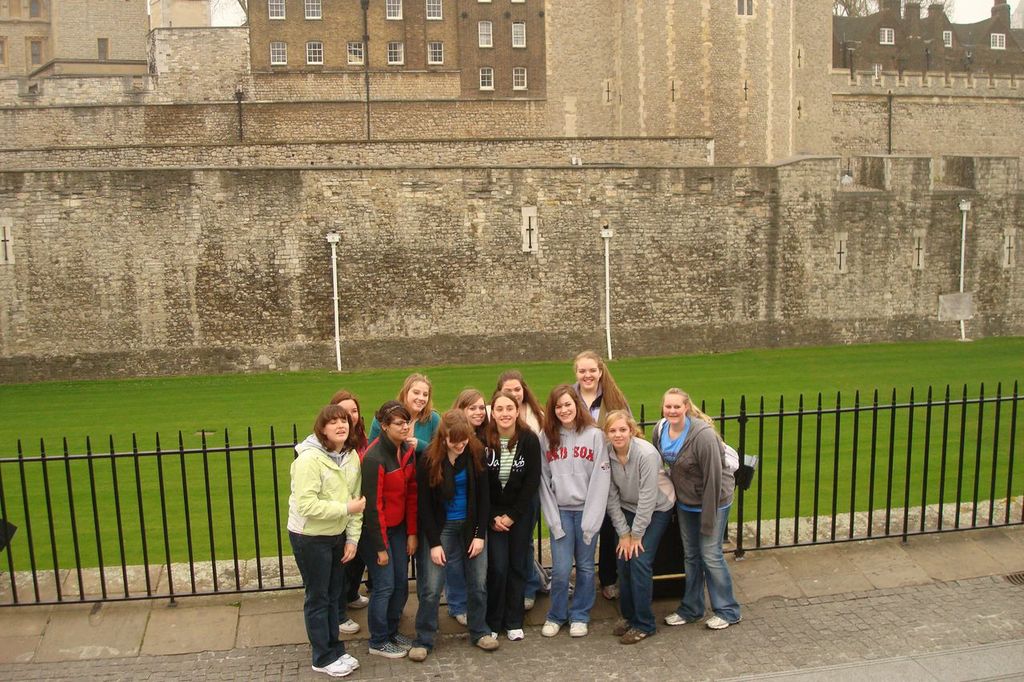
When I visited the Tower of London (which is really a complex with multiple buildings and grounds) with students in 2008, I had no idea that I had a relative who had been imprisoned there. Here are some pictures I took.

Traitor's Gate
Cages for the ravens kept at the Tower

Students outside the Tower
Edward & Hannah (Partridge) Gove
Joseph & Mary (Gove) Sanborn
Samuel & Mary (Sanborn) Prescott
Jeremiah & Mary (Hayes) Prescott
Elisha Prescott
Thomas & Hannah (Prescott) Edgecomb
Oliver Smith & Mary (Edgecomb) Philbrick
Benjamin & Jane (Matthews) Philbrick
Francis Llewellyn & Lizzie (Philbrick) Cotton
Ray Everett & Annie (Gibbs) Cotton
Fern Lyndell Cotton - my grandmother

Sources:
Dearborn, Clarkson. "Seabrook Sketches." The Granite Monthly 15 (1893): 335-41.Google Books. Web. 26 June 2013.
Gove's Rebellion of 1683
1981 Nashua Telegraph article in Google News Archive

Thursday, February 21, 2013

Battle of Britain

Tomorrow is the one year anniversary of my genealogy blog! I am celebrating by reposting my first story. 

Thomas Wilson, author of A Christian Dictionarie


Thomas Wilson was the minister at St. George the Martyr Church in Canterbury from 1586 to 1622.  He was also a prebendary* of Canterbury Cathedral. He was buried in his parish on the 25th of January 1621-22. He was the first to attempt to compile a dictionary of the Bible in English. The first edition appeared in 1612 and a second in 1616. Other editions were published after his death. He also published other works including Commentarie upon the most divine Epistle to the Romans  and Christ's Farewell to Jerusalem. 

In attempting to find information about the church, I discovered an interesting but sad story. The church was destroyed during a bombing raid that devastated much of downtown Canterbury in World War II. All that remains is one tower. On the night of May 31st/June 1st, 1942 Canterbury was targeted as part of the so-called "Baedeker Raids."** This attack was likely a reprisal for an R.A.F. bomber raid on Cologne the night of May 30th. About one fifth of the City of Canterbury was destroyed that night as about 100 bombs and 6,000 incendiaries were dropped in two and a half hours. Fire damaged many properties because the majority of buildings were made of timber. Forty-three people died, forty were seriously injured and forty-one had less serious injuries. Follow-up attacks came on June 3rd and June 7th but these were not as destructive as the June 1st attack. 


The church had a long history. There is evidence of a church on the site from 1100 A.D. It had been enlarged, most recently in 1879 when another local church was closed and the two congregations merged. 

Quotes about Thomas Wilson:
Robert Cushman (a member of the Pilgrim group in Leiden) - "a very excellent preacher in Canterbury, who was both a lover of goodnesse and good men." 

Historian Peter Clark - "probably the most distinguished preacher in early Jacobean Kent [who preached] themes from middle-of-the-road Calvinism." 

*prebendary - an honor granted to senior priest in the Anglican Church usually awarded for long and dedicated service to the diocese. 
** Baedeker was the publisher of an English travel guide book reportedly used by the Germans to choose their non-military targets. They looked for cities with at least three stars for historical significance. 

10th Great-Grandfather
Rev. Thomas Wilson & Christian Ower
Theophilus Wilson & Elizabeth
Seaborn Wilson & David Fiske
Anna Fiske & Timothy Carter
Benjamin Carter & Sarah Stone
Timothy Carter & Sarah Walker
Timothy Carter & Frances Freeland
Elias M. Carter & Rebecca Williamson
Augustus M. Carter & Mary Frances Stanley
Edward M. Carter & Fannie May Capen
T. Richard Carter & F. Lyndell Cotton

Wednesday, November 21, 2012

"Let...Thanksgiving Bee Made For All Men"

"Let supplication and Prayer and Thanksgiving bee made for all men...Remembrance of the good done to us...Confessing God to be the Author and giver of it...Cheerfulnesse, being glad of an occasion to praise him, and doing it gladly, with joy"  ~ Thomas Wilson

Thomas Wilson, minister at St. George of the Martyr Church in Canterbury never came to the colonies but his ideas reflected the ideals of the early New England immigrants. 

Wilson was the author of A Christian Dictionarie. The dictionary has been used to provide clues regarding the Pilgrim's religious motives and it allows scholars to have some idea of how Pilgrims interpreted the Bible and used its words.The dictionary is listed in inventories of the estates of famous Pilgrims - William Bradford, Samuel Fuller and Myles Standish. Thomas Shingleton, John Kemble, and Robert Cushman were members of Wilson's congregation in Canterbury and later moved to Leiden and joined the Pilgrim Leiden Church. The Pilgrims were serious about studying the Bible and used a variety of books to help them in their studies. Wilson's dictionary was a best-seller and Dr. Ian Green called it the most popular Bible study aid. Given the importance of Bible study in the daily lives of the Pilgrims, this dictionary must have been highly regarded. 

So what does all of this have to do with Thanksgiving? Well, Wilson used his own definitions of everyday words and included quotes from the Scriptures to provide examples. Wilson's dictionary offered a religious definition of thanksgiving that included “An acknowledgement and confessing with gladnesse of the benefits and deliverances of God…to the praise of his Name" along with the quote that starts this post. The Pilgrims make repeated references to thanksgiving and it's pretty cool that one of my ancestors had such influence on their worship and daily lives. 


Robert Cushman (a member of the Pilgrim group in Leiden) called him "a very excellent preacher in Canterbury, who was both a lover of goodnesse and good men." 

Historian Peter Clark wrote the Thomas Wilson was "probably the most distinguished preacher in early Jacobean Kent [who preached] themes from middle-of-the-road Calvinism." 


10th Great-Grandfather
Rev. Thomas Wilson & Christian Ower
Theophilus Wilson & Elizabeth
Seaborn Wilson & David Fiske
Anna Fiske & Timothy Carter
Benjamin Carter & Sarah Stone
Timothy Carter & Sarah Walker
Timothy Carter & Frances Freeland
Elias M. Carter & Rebecca Williamson
Augustus M. Carter & Mary Frances Stanley
Edward M. Carter & Fannie May Capen
T. Richard Carter & F. Lyndell Cotton

Saturday, November 3, 2012

Surname Saturday - Gawkroger of Platts

One of the more interesting names in my family tree is Gawkroger. Depending on which source one finds, it means something along the lines of "awkward or clumsy" Roger or "left-handed" Roger. Tracking down the Gawkrogers gets interesting as some of the family of immigrants used the surname Platts. Heather Wilkinson Rojo wrote a post about the family last July. Platts is a place name and evidently used to distinguish my ancestors from those of another "awkward/clumsy/left-handed Roger."

Names and History: People, Places, and Things by George Redmond uses the Gawkroger surname to demonstrate the linguistic and social development of a surname (p. 38-39). "In a roll of 1545, for example, six individuals were taxed in Sowerby and two more in Hartshead and Liversedge. It was not a prolific surname but probably more numerous than these figures suggest, for there would be some families who were not sufficiently well off to be included." He goes on to trace the evolution of the name to various aliases that different branches started to use. The name Platts came from a property and the family was said to be "of Platts" and some eventually took Platts as their surname. Another branch of the family lived near Sowerby Bridge and took the surname Brigge. Yet another became Barker - possibly from the northern England word for a tanner. He concludes "The lesson for genealogists is clear, for while they would probably accept that Gaukroger might have such variants as Gawkroger and Gaukrodger, or even Corkroger and Cockroger, they would find it more difficult to to come to terms with aliases such as Barker, Platts, Brigg, Ro(d)gers, Gawke, and even Cockrobin."

Mary Gawkroger was the daughter of Abram and Martha (Riley) Gawkroger. She married John Prescott on April 11, 1629 in Sowerby, Yorkshire, England. The couple went first to Barbadoes and then became one of the first families of Lancaster, Massachusetts.

Mary Prescott married Thomas Sawyer and had a daughter, Mary.
Mary Sawyer married James Houghton and I descend from two of their sons, Ephraim & Thomas.

Ephraim Houghton & Hannah Sawyer
Elisha Houghton & Meriah Pierce
Moses Houghton & Martha Haskell
Sally Houghton & James Dunham
Florilla Dunham & Asa Freeman Ellingwood
Nina Ellingwood & George Gibbs
Annie Florilla Gibbs & Ray Everett Cotton
Fern Lyndell Cotton

Thomas Houghton
Hannah Houghton & John Pierce
Meriah Pierce & Elisha Houghton (first cousins, once removed)

Names & History: People, Places, and Things

Wednesday, October 24, 2012

My DNA Profile

Ancestry.com started a new DNA testing program that is open by invitation only while it is in Beta testing. Because I've been a customer for quite awhile, I received an email invitation to take part in this program and they were offering a significant discount to those who accepted. Having seen the testing done on Finding Your Roots, the PBS show about celebrity genealogy, I was intrigued to find out what my DNA would say about my ancestors. My own research has shown that most of my ancestors from both my father's and my mother's families came from the British Isles to the American colonies in the early 1600s. While I figured I would have predominantly British ancestry, I was still surprised when the results came back as 100% British Isles.  No traces of intermingling genes with marauding Vikings or Barbarians, no evidence of dalliances with Frenchmen, Germans, or Italians...I seem to be about as white, Anglo-Saxon, Protestant as it is possible for one to be. A bit boring to some but it does make tracing ancestors a bit easier. 
It does seem to explain my love for the British Isles. And why it is that I felt so comfortable and at home whenever I've visited England or Scotland. So I'll continue to embrace my ancestors and the culture I love. I'll find diversity in friends to make up for the lack of diversity in my genes. I had a great time last year helping my students trace their family trees to Italy, Scandinavia, and Germany. 

Sunday, June 24, 2012

Black Sheep Sunday - I Did It My Way!

Bachilder
Bachiler Monument - Founder's Park, Hampton, NH

Stephen Bachiler (variously spelled Batchellor, Batchelder etc) was a minister in Wherwell, Hampshire, England and then in the nearby village of Newton Stacy. He married and began a family and settled into life. His six children, by his first wife, were all born in Wherwell - a nice balance of three sons and three daughters. His first wife was a close relative of Rev. John Bate and many sources give her name as Ann Bate, but the documentation is lacking. His ministry spans a time of ecclesiastical strife as Puritans challenged the Church of England and leveled accusations of corruption and abuse. Despite the optimism among the Puritans that accompanied the ascension of King James I to the English throne, he proved no friend of the Puritan point of view and instead sided with the established church. King James I declared that he would "make them conform or harry them out of the land."  Rev. Stephen Bachiler was one of those who was removed from his pulpit for nonconformity. His son, Stephen Jr., was expelled from Magdalen College, Oxford University in 1610 and in 1613 father and son were sued by a clergyman for slander because they had allegedly written ""some scandalous verse" and were "singing them in diverse places." At the age of 44, he began a nomadic life that would take him to the colonies and eventually back to England. 

The Great Migration profile for Stephen Bachiler states that he came to the colonies in 1632 on the William and Francis. Before he immigrated, he was twice widowed and when he crossed the ocean he was married to his third wife, Helena, age 49. He was unusually old for an immigrant at age 71. Based on records, it is believed that Helena died sometime before May 1647. He moved frequently starting in Lynn, then possibly to Ipswich, was in Yarmouth in 1637/8, Newbury in 1638, Hampton, NH in 1639 and Portsmouth, NH in 1644. He left Lynn because he and some of his loyal followers were at odds with the rest of the congregation. In Yarmouth at age 76, he began his ministry yet again. An entry in John Winthrop's journal states that the group was very poor and taken over by others. Wherever he went dissension seemed to follow. In 1644, Winthrop remarked that  "Mr. Bachellor had been in three places before, and through his means, as was supposed, the churches fell to such division, as no peace could be till he was removed." In 1639, Bachiler moved to the new settlement at Hampton, NH. The Rev. Timothy Dalton was to share the pulpit with him - presumably because of his advanced age. 

 The final conflict with his congregation is reported in Winthrop's journal: Bachiler despite  "being about 80 years of age and having a lusty comely woman to his wife, did solicit the chastity of his neighbor's wife." This "lusty comely" wife would be Helena at age 58. She must have been a pretty sexy 58 as most women I know would not fit that description although they might aspire to it. There is no record of how this situation was resolved but in 1643-4, the town of Exeter invited Rev. Bachiler to be their minister and he hit the road again.

In 1648, he married for the fourth time, Mary, the widow of Robert Beedle. She had been living with him as his housekeeper and the community seems to have suspected that it was more than a working relationship prior to their marriage. Apparently, Rev. Bachiler at the advanced age of 87, was no longer quite able to keep up his end of the bargain and his wife left and went to live in Kittery with George Rogers. In April 1650 the court "ordered that Mr. Bachelor and Mary his wife shall live together, as they publicly agreed to do, and if either desert the other, the Marshall to take them to Boston to be kept until the next quarter Court of Assistants, to consider a divorce."  They did not live together or divorce. Sometime in the early 1650s, he returned to England. Mary became pregnant by George Rogers and was sentenced to receive 39 lashes at Kittery's town meeting and be branded with the letter "A." Some believe this story was the inspiration for the novel, The Scarlet Letter. 

Rev. Stephen Bachiler died in London at nearly 100 years old! Whether you find him an inspiration or an idiot, he lived the sentiment expressed by Frank Sinatra:

And now, the end is here 

And so I face the final curtain 

My friend, I'll say it clear 
I'll state my case, of which I'm certain 
I've lived a life that's full 
I traveled each and ev'ry highway 
And more, much more than this, I did it my way


This blogger has provided an even more detailed account of his life

Other sources of information:
http://www.hampton.lib.nh.us/hampton/biog/bachilerunforgiven.htm
http://o.mfcreative.com/f1/exports/7/76c42563-6769-4cc3-a652-f834df871431/Stephen%20-%20adulterous%20wife1.pdf
The Great Migration Begins by Robert Charles Anderson accessed at www.newenglandancestors.org

Connections to my family:
9th great-grandfather of Clayton Leonard Blake - my grandfather
9th great-grandfather of Linona Alice Blake - my grandmother
9th great-grandfather of Fern Lyndell Cotton - my grandmother
AND grandson Nathaniel married my 7th great aunt, Mary Carter - completing a connection to all 4 of my grandparents!


Wednesday, June 20, 2012

A Tough Childhood


William Yates' life as a boy is only documented through oral tradition. Unfortunately, his children and grandchildren do not recall the exact same information.

His youngest son, Sylvester, said, "I have heard my father say his father bound him out to a farmer who lived near Portsmouth, NH. This man treated him so that finally father ran away. He was caught and brought back but told the farmer that the next time he ran away, they wouldn't catch him. Afterwards, he ran away again and that time they didn't catch him." Martha Yates Littlefield, William's youngest daughter, said " I have heard father tell of how he was bound out to an Irishman when he was very small and how the Irishman abused him so that he ran away."

Two of his grandsons, Judge Edward M. Yates and Gilbert W. Yates, agreed in saying that they never heard William speak of his parents at all, any more than as if he knew not who they were. Both did recall he worked for a NH farmer for wages rather than being bound out. They remember him saying he had to work very hard and got very little schooling compared to other boys. Judge Yates spent much of his childhood in the home of his grandparents and stated "I always had the impression that he was some sort of castaway, a homeless boy, who in some way drifted to this country and got work in Portsmouth."

William told the following story to Gilbert. "The farmer was slack about having firewood on hand for the kitchen fireplace. His wife stood it as long as she could and then one noon when they were called for dinner, they found on the table was raw meat, potatoes, and unbaked biscuit. The farmer put in the next few days getting up wood."

Regardless of where he came from or what he did as a young boy, William left Portsmouth when he was fifteen and went to work at a brickyard in Saccarappa, near Portland, Maine. He also drove a stagecoach somewhere in the Portland area. When he was 18 or 19, he moved to Minot, Maine.

William Yates & Martha Morgan
Moses Yates & Martha Whittle
Gilbert W. Yates & Laura Emmons
Estes Gilbert Yates & Eva Delphinia Hayes
Linona Alice Yates

Sources:
William B. Lapham & Silas P. Maxim (1884 & 1983), History of Paris, Oxford Co., Maine (New England History Press, Spmersworth, NH (1983).


Yates, Edgar Allan Poe, The Yates Book: William Yates and His Descendants; the History and Genealogy of William Yates (1772-1868) of Greenwood, Maine, and His Wife, Who was Martha Morgan, together with the line of Her Descent from Robert Morgan of Beverly (Old Orchard, Maine, 1906).

Monday, April 23, 2012

Happy St. George's Day!

St. George is the patron saint of England and St. George's Day is celebrated on April 23rd. In honor of all my British ancestors, I present a few facts about St. George. It's also my mom's birthday so "Happy Birthday, Mom!" 


St. George wasn't English and there is so much mythology surrounding him that it is hard to distinguish actual facts. The best guess is that St. George was born in modern-day Turkey in the 3rd century. The story is that his parents were Christian and after his father died, George's mother moved back to her native Palestine, taking George with her. George became a soldier in the Roman army. Emperor Docletian began a campaign against the Christians at the beginning of the 4th century. Legend has it that George resigned from the army and tore up the Emperor's order against Christians in protest. George was thrown in prison and tortured but he refused to deny his faith. Eventually he was dragged through the streets and beheaded. 


The story of St. George slaying a dragon originated in the 15th century. As entertaining as it is, it must be relegated to the realm of mythology. 
File:Stgeorge-dragon.jpg


St. George began to be linked to England during the Crusades. One story that is recorded in stone over the south door of a church at Fordington, Dorset, tells of his miraculous appearance and leading crusaders into battle. When Edward III founded the Order of the Garter, he assigned St. George to be its patron saint. St. George's Chapel at Windsor Castle was built by Edward IV and Henry VII as the chapel of the order. Since that time St. George has been regarded as a special protector of the English. 


St. George Chapel Windsor, England

The flag of St. George is a red cross on a white background and is incorporated into the Union Jack. 


In 1940 King George VI inaugurated the George Cross for "acts of the greatest heroism or of the most conspicuous courage in circumstances of extreme danger." The award is usually awarded to civilians. It depicts St. George slaying the dragon on a silver cross. 
Info source:
http://www.bbc.co.uk/religion/religions/christianity/saints/george_1.shtml

Image sources:
http://en.m.wikipedia.org/wiki/St._George_and_the_Dragon
http://www.google.com/imgres?
http://www.topnews.in/george-cross-theft-case-takes-another-turn-2241432
http://www.inetours.com/England/Windsor/photos/St-Georges_9927.html
http://fandangman.blogspot.com/2010/06/its-all-flags.html
http://www.ibiblio.org/wm/paint/auth/altichiero/